
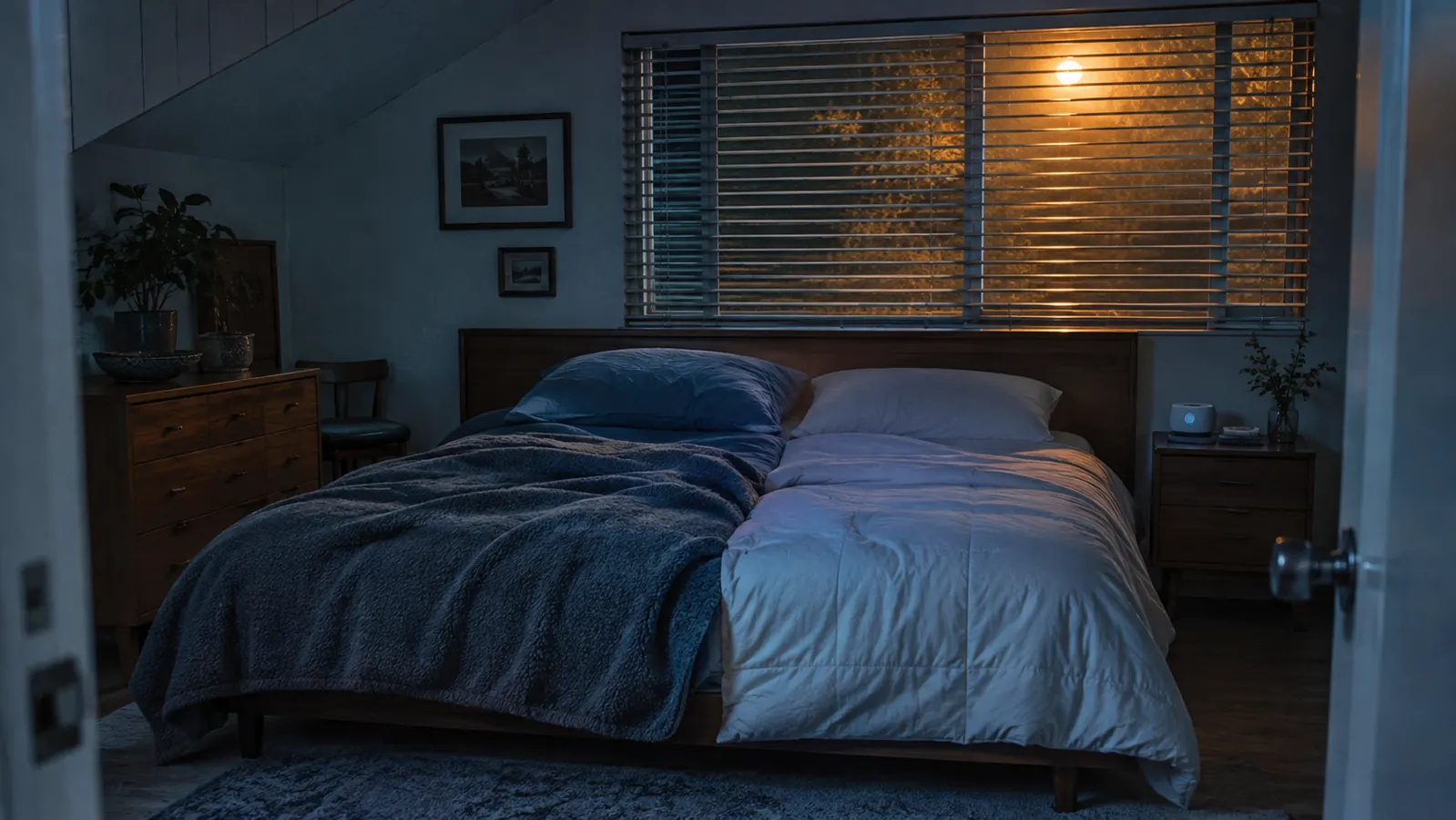
Linda goes to bed around ten. I go at nine, because my shift at the hospital starts at six and I am up at a quarter to five. That ninety minute gap used to be the worst part of my night. I would lie there listening to the bus come up the street while my mind went back over the boiler room checklist, then the parking lot, then a conversation from 1998. She would read with the lamp on and I would pretend to be asleep so she would not feel bad about the light.
About eighteen months ago I bought a YnM weighted blanket, 15 pounds, 48 by 72 inches, and put it on my half of the bed. Not the bed. My half. That distinction is the entire article, and it is the thing most people get wrong when they shop for one of these. You are not buying bedding for a shared bed. You are buying a heavy object for one person who happens to sleep in a shared bed, and every decision after that follows from it. Linda has never used it and has no interest in using it. She runs warm, and the weight is not her idea of comfort. That is fine. It was never hers.
One blanket, one side of the bed. That is the whole idea.
The 48 by 72 size is built for a single adult with coverage that follows the body, not for draping across a queen. It is the reason this works when two people share one room and only one of them wants the weight.
Amazon Check Today's Price on Amazon →Step 1: Measure Your Half of the Bed, Not the Whole Bed
A queen mattress is 60 by 80 inches. A king is 76 by 80. The YnM blanket I sleep under is 48 by 72, which is smaller than the mattress in both directions, and that is on purpose. It is sized to cover one adult from roughly the shoulders to the feet with a little overhang at that person's sides, not to fall over the edges of the bed. Buy a blanket that spans the whole mattress and the extra fabric and extra fill end up on your partner, who did not ask for either one and will notice within about four minutes.
Before you order anything, lie on your back on your side of the bed and have somebody note where your shoulders sit and where your feet end. That span, plus a few inches, is the number you care about. If you are six foot two, a 72 inch length will leave your feet near the edge and you will feel it. If you are five foot four, most of that length is going to end up bunched at the foot of the bed, which is annoying but not fatal.
The other honest option is one blanket per person. Two 48 by 72 blankets side by side on a queen leaves a seam down the middle of the bed and, in our house, a negotiation about who folds what. We did not go that way because Linda did not want one at all. If you both want weight, two smaller blankets beat one enormous one every time, because each of you can pick your own weight and nobody has to fight over the covers at two in the morning.
Step 2: Pick the Weight by the Person, Then Go One Notch Lighter
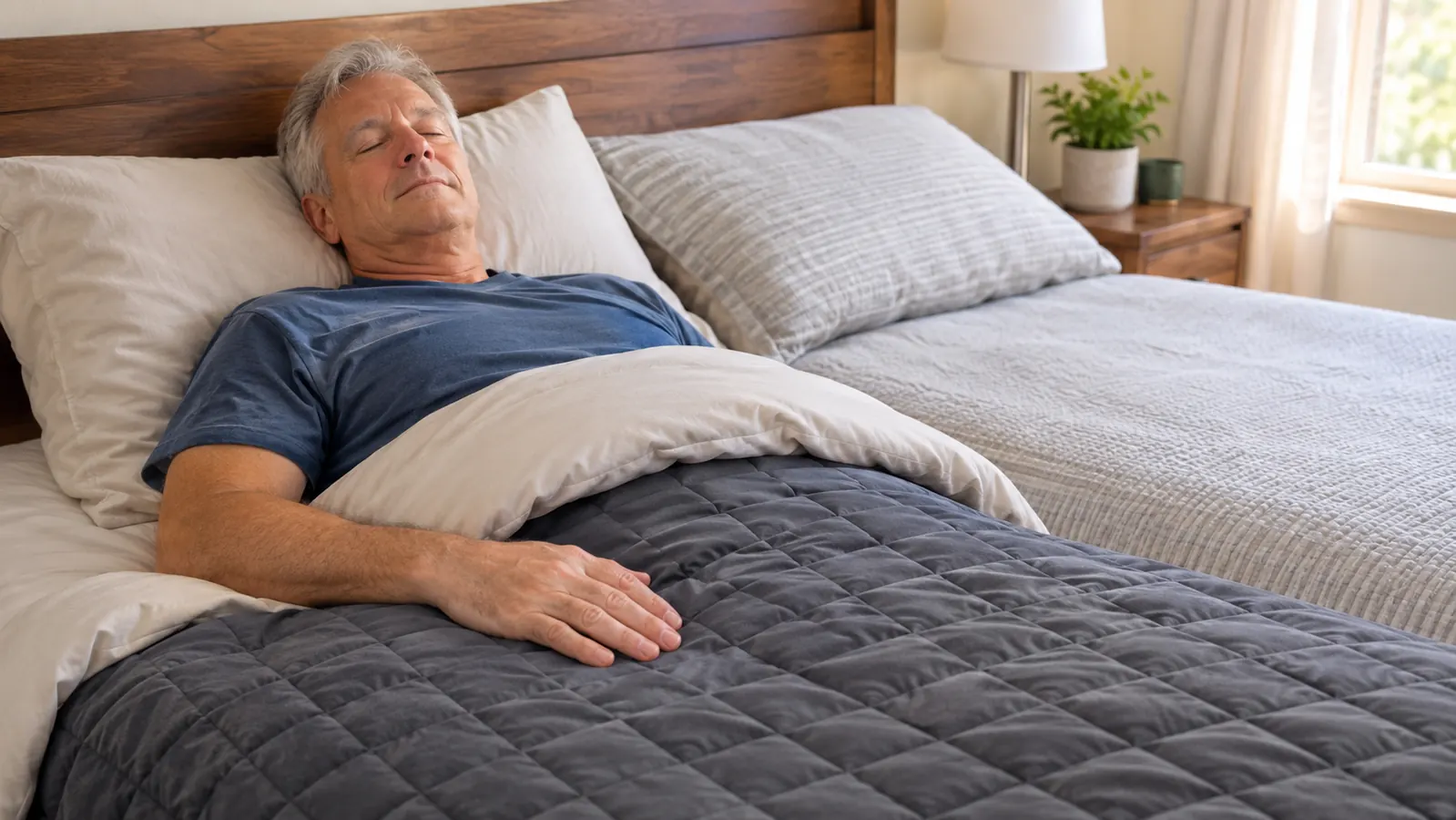
The common starting point is around ten percent of body weight, and 15 pounds is the size most adults land on. That is the size I bought and it has been right for me. What I would tell you, though, is that in a shared bed you should bias lighter rather than heavier. A heavier blanket is not a better blanket. It is a blanket you cannot move in the dark with one hand while your partner is asleep eighteen inches away.
Think about the actual mechanics of your night. You will want to shift the thing off your shoulder at some point. You will want to pull it back up when the room cools off at four in the morning. You may need to get out of bed without waking anybody. A blanket you have to fight is a blanket you will stop using by the second week, and then it lives on the floor on your side, which is not what you paid for.
There is a second reason to stay lighter in a shared bed, and it has nothing to do with you. If your partner wakes up and needs to reach over, or if somebody has a bad night and needs the light on, a 20 pound blanket between the two of you is a nuisance. Fifteen pounds on one half of a queen is something I can fold and lift with one hand in the morning. That was a real consideration for me, not a marketing line.
Step 3: Settle the Temperature Question Before You Spend Anything
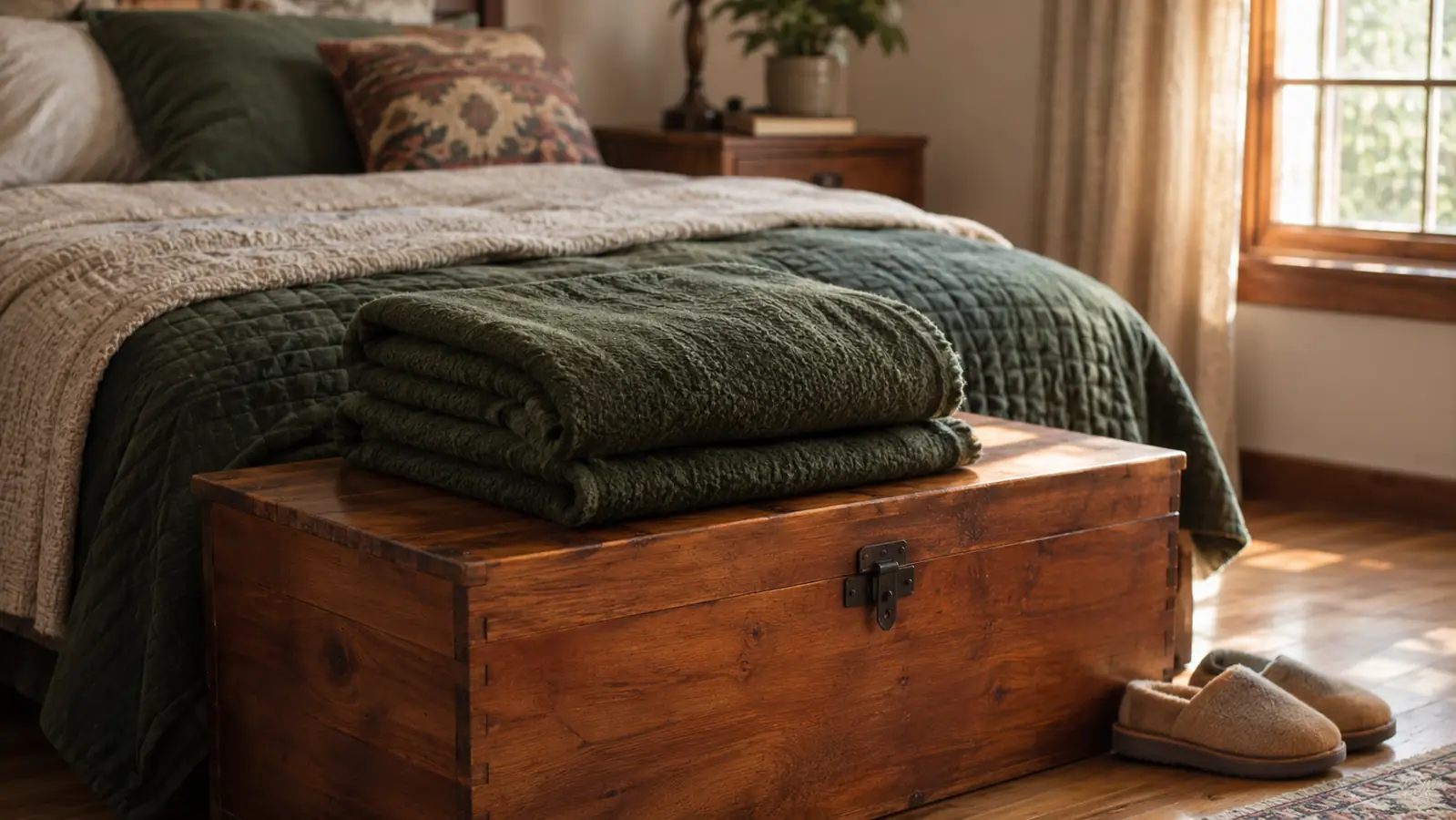
The YnM is microfiber with a polyester fill, and that combination sleeps warm. It is not a cooling blanket and I am not going to pretend it is. What makes it workable in our room is layering. From about October through May it goes over the bottom sheet and under the comforter. In the last two weeks of July and the first two of August it lives folded on the cedar chest at the foot of the bed, because our bedroom runs hot and I am not a martyr.
Our house is a 1960s split-level with central air, and the main bedroom faces a street with a bus route. That room gets the worst of the afternoon sun and holds it. If your bedroom is the warm room in the house, plan on the blanket being a cool-weather object, or plan on running the air colder than you otherwise would. Linda runs warm by nature and would tell you the same thing about any heavy bedding: the weight is lovely until you are sweating under it at 2 a.m.
The cheapest thing you can do here is test the temperature question for free. Sleep one night with an extra folded quilt on your side only and nothing on your partner's side. If you wake up clammy, a weighted blanket is going to be worse, because it traps more heat than a quilt does. If you sleep better, you have your answer for a fraction of the cost of finding out the hard way. That one experiment would have saved me a return on a different product two years earlier.
Step 4: Check the Construction, Because Fill Migrates
This is the boring section and it is the one that decides whether the blanket is still usable in two years. The YnM listing specifies 2 by 2 inch compartments, which is small. Small compartments matter because the fill inside a weighted blanket is what makes it heavy, and fill that can travel will travel. You have seen the version of this where all the weight ends up in one corner and the rest of the blanket is a sheet. A grid that tight keeps the fill where it was sewn.
The second detail is the loops. This blanket has 16 of them for attaching a duvet cover, which is sold separately. That sounds like an accessory you can skip. It is not, if you plan to wash the thing more than twice a year. A cover takes the wear and the sweat, and you wash the cover instead of wrestling the whole 15 pound blanket into a machine. Without loops, a cover slides around all night and you wake up tangled in both.
The care instructions say machine wash, and I would check your drum size before you trust that. A 15 pound blanket is a lot of fabric and a lot of fill for a standard home washer. Ours goes to the laundromat on the corner where the machines are big enough to actually move it around, and it comes back fine. Do not dry it on high heat whatever you do. Also worth noting: the seven layer construction and the twill weave are the parts that keep the surface from feeling like a plastic tarp against your skin, which is more than I can say for the cheap one I tried before this.
Step 5: Plan the First Week Like It Is a Real Adjustment
It took me four nights to get used to the weight. Night one felt like being tucked in by a very serious person who did not intend to negotiate. I slept, but I woke up twice and each time I had that half second of not knowing why my legs were pinned. Night two was better. Night three I stopped noticing it at all. Night four I was asleep before Linda finished her chapter, which had not happened in months.
Plan for that week instead of judging the blanket on night one. Tell your partner what you are doing so the light and the rustling are not a surprise. Keep the blanket on your side and keep it folded in the morning rather than dragged up over the pillows, because a heavy blanket that has been slept on all night is not something you want to re-make the bed with. Ours gets folded and laid on my side over the sheet, and the comforter goes over everything like normal.
And give yourself permission to take it off in the middle of the night without deciding the whole experiment failed. I still do, maybe twice a month, usually in a warm stretch or when I have a cold. The blanket is not a commitment and it is not a cure. It is a tool that helps some nights and does nothing on others, and the sooner you accept that, the less annoyed you will be when it does not work on a Tuesday.
Night four I was asleep before Linda finished her chapter. That was the whole test, and I have not come up with a better one since.
One more thing about the first week, and this one surprised me. The blanket changed how I got back to sleep after the 2 a.m. wake-up, not how often I woke up. That is a smaller claim than the internet makes for these things, and it is the honest one. I still wake up. I just do not lie there for forty minutes running through the day anymore, which is worth something when the alarm is set for a quarter to five.
What Else Helps
The blanket was the fourth change I made, not the first, and I would not want you to think it did all the work. The first was a white noise machine on my nightstand, about three feet from the bed on the street side, bought three years ago for the bus route. It runs all night. It took Linda about a week to stop noticing it and now she misses it when we travel. If traffic noise is part of your problem, that is a better first dollar than a blanket.
The second was a contoured sleep mask for the streetlight that comes through our blinds. I wear it and Linda does not. The third was a shredded memory foam cooling pillow for Linda, who runs warm and kept flipping her pillow to the cool side all night, which woke me up. She took some of the fill out the first week to get the height right and keeps the extra in a bag in the hall closet. The newest thing is a sunrise alarm clock, because the 4:45 wake-up in a dark room in December was miserable.
The one thing I will say plainly: if you snore loudly, or you wake up gasping, or you fall asleep in parked cars, a weighted blanket is not your answer. I nodded off in the hospital parking lot before a shift about three years ago and that scared me enough to get a home sleep test, which ruled out apnea. If you have not done that, do it before you spend anything on bedding. Your doctor can order it and it is a night in your own bed. No blanket on earth fixes a airway problem, and I would rather you heard that from a maintenance supervisor than from nobody.
What I would tell you, sitting at my kitchen table with a cup of coffee at 8 p.m. because I go to bed in an hour, is that a shared bed is a series of small negotiations and the blanket is one of them. One person wants weight, one person wants cool air and a light cover. You can have both. You just have to stop shopping for the bed and start shopping for the person. That is a 48 by 72 blanket on one side and a thin comforter on the other, and eighteen months in, neither of us has complained.
The blanket was the fourth change, not the first. It is still the one I would replace tomorrow.
15 pounds, 48 by 72 inches, seven layers, 2 inch compartments to keep the fill where it belongs, and 16 loops for a cover when it is time to wash it. Sized for one person in a bed built for two.
Amazon Check Today's Price on Amazon →