
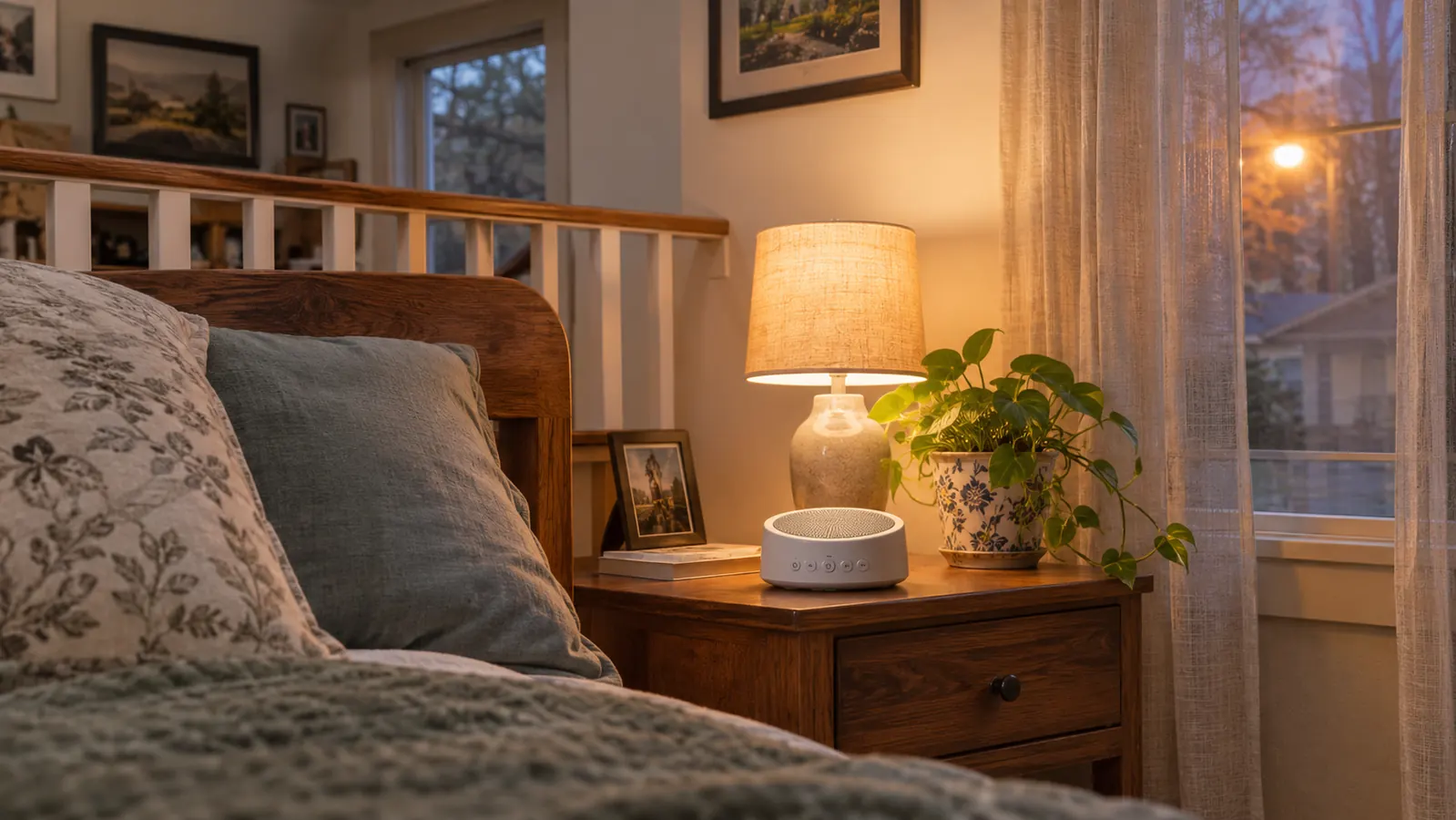
The 4:52 bus is not loud. That is what makes it impossible to sleep through. It is a low diesel rumble that builds at the top of our street, brakes at the corner, idles while somebody gets on, and then pulls away. Just as the house settles, the 5:12 comes through. I am a building maintenance supervisor at a hospital in Clifton, New Jersey, my shift starts at six, so I am up at 4:45 anyway. For years the bus was not a problem. Then it became the reason I was awake at 3:20, staring at the ceiling and listening for a vehicle I knew was coming. About three years ago I put the Yogasleep Dohm Classic on the nightstand on the street side of the bed, three feet from my pillow, and flipped the switch.
The Dohm Classic is made by Marpac, and Marpac has been building this same basic idea for over sixty years: a real fan inside a small housing, moving air through a set of openings, with two speeds and an adjustable tone. It is corded. It has a switch. That is the whole feature list. No app, no timer, no display, no light, no menu of sounds to scroll through at eleven at night. Marpac sells it as a sleep aid and as an office privacy tool, which are the same job wearing different hats. Reviewing a year of it is a strange exercise, because the machine does not change. What changed was me.
The Quick Verdict
One sound, two speeds, zero cleverness. After a year of that bus coming through our street every morning, a fan that never loops turned out to be exactly the fix, and I still switch it on before I get into bed.
Amazon Check Today's Price →The Bus Route Still Runs. I Just Don't Hear It Anymore.
The first thing I bought for this bedroom and the only thing I have never once considered replacing. One switch, two speeds, and a tone you dial in by ear. It has run every night, all night, for three years.
Amazon Check Today's Price on Amazon →How I've Used It
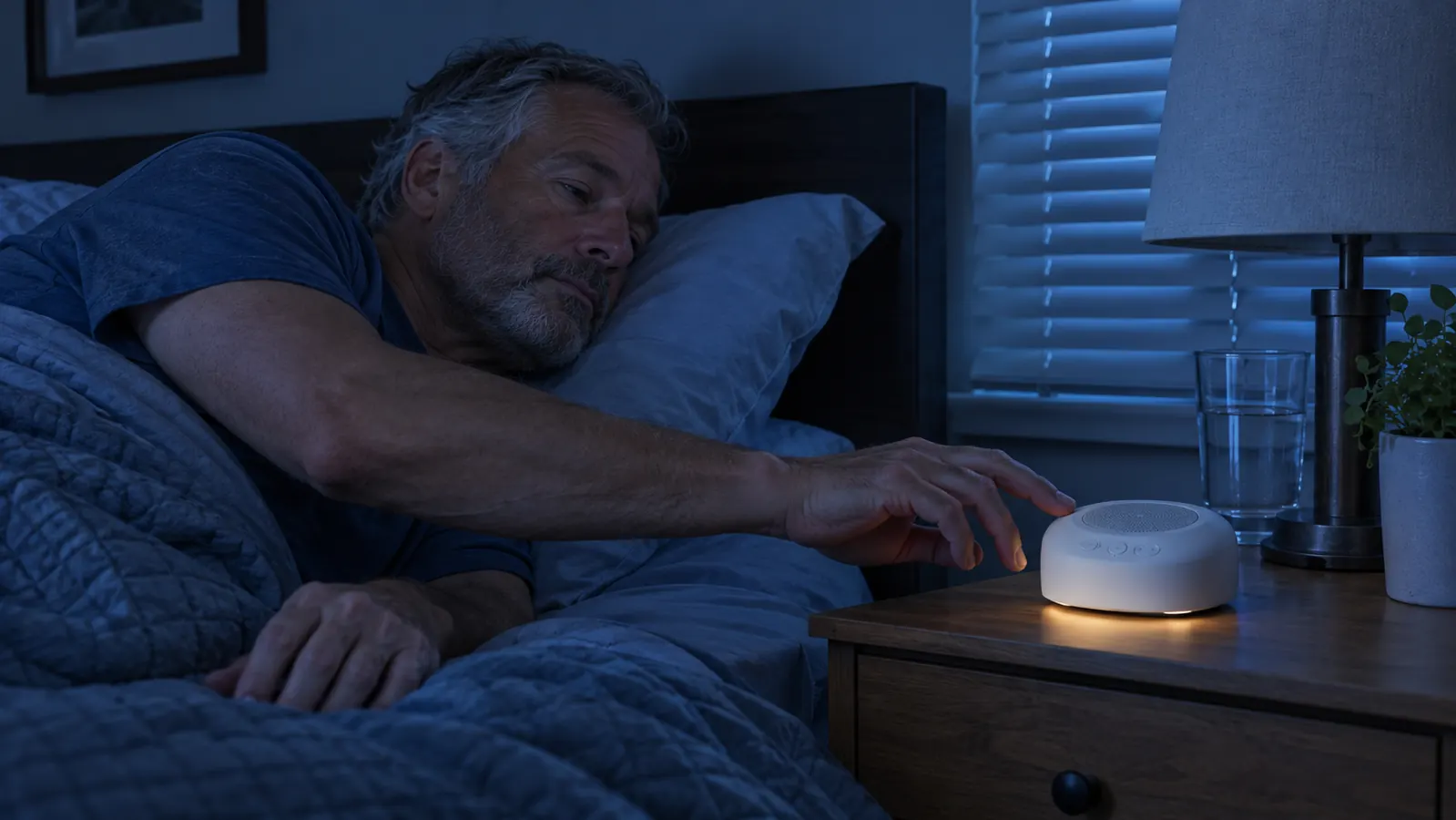
The machine sits on my nightstand on the street side of the bed, roughly three feet from my pillow, close enough that the fan covers the window and far enough that I am not hearing the motor itself. It runs on the low speed. I turn the collar until the bus rumble and the fan sound sit in the same register, which takes about four seconds and is the only tuning the thing has ever needed.
It runs from the moment I get into bed until the alarm goes at 4:45. All night. It has run every night since I bought it. The power cable is seven feet, which matters more than it sounds, because our nightstand is nowhere near an outlet and seven feet reaches the one behind the dresser without an extension cord lying across the floor where I would find it barefoot at 4:45 in the dark.
Linda, my wife, is a light sleeper and sleeps warm. She did not want a fan noise in the room and said so. She gave it about a week, then stopped mentioning it, and now she notices on the rare night I forget to switch it on. That is the entire testimonial. It took seven nights to stop being a noise and become the absence of noise.
There is a second job it does that I did not buy it for. My mind races at 2 a.m. the way a lot of men in their late fifties will tell you theirs does, and the fan gives that 2 a.m. brain something steady to hold on to that is not the list of boilers and elevator inspections waiting for me at six. It is not a cure for anything. It is a small piece of even sound in a dark room, and at 2 a.m. that is often enough to get me back under.
What a Real Fan Actually Sounds Like
The question people ask me is whether the loop gets annoying. That is the failure mode of every phone app and every cheap machine that plays a recorded track: after twenty minutes your ear finds the seam where the sample restarts, and once you have heard it you cannot unhear it. The Dohm has no sample. It has a fan moving air, so the sound is continuous and very slightly uneven in a way a recording is not. There is nothing to restart. Three years in, I have never caught it repeating.
It is also broadband, so it covers a wide spread of frequencies at once rather than a single tone. That is why it works on a bus and a garbage truck and a neighbor's leaf blower, and why it does very little about a door slam or a dog barking two houses down. Sharp, sudden sounds cut straight through it. Steady low rumbles do not. Since the street noise that was waking me is exactly the steady low rumble kind, the machine and I happen to be a good match.
I borrowed a friend's digital machine for a week to compare. It offered ocean, rain, and something labeled brook, and every one of them had that recorded quality underneath. I also spent two minutes scrolling through options at bedtime, which is two minutes of being awake and making decisions. The Dohm gives you nothing to scroll. You flip a switch. That turned out to be the feature I care about most.
The other thing I did not expect is how fast the sound stops registering as sound. The first week I noticed it constantly. By the third week it had become part of the room, the same way the ceiling fan is part of the room. Guests sleep in that bed maybe twice a year and both times they have asked what the noise was. That is the tell: you only hear it if you are not used to it.
Two Speeds, One Switch, and a Tone You Set by Ear
The controls are a switch on the side and the two speed settings behind it. Low is what we use, night after night. High is noticeably louder and a touch brighter, and I have needed it exactly twice: once when the town decided to repave our street at eleven at night, and once when Linda had a stomach bug and I wanted her to sleep through the sound of the bathroom door.
Beyond the speeds there is the tone adjustment, which is just the housing: you turn the collar and the openings shift, changing how much of the fan's upper range reaches you. Turned one way it is airier and closer to a hiss. Turned the other it is deeper and closer to a rumble. Mine has sat about halfway since the first week and I have not touched it since, which is either a sign that it was easy to dial in or a sign that I am not fussy. Probably both.
The physical size is genuinely small, 5.75 by 5.75 by 3.25 inches and 1.6 pounds, so it lives on a crowded nightstand next to the lamp, the alarm clock, and my glasses without anything getting rearranged. It has been knocked off that nightstand twice in three years, once by me reaching for the alarm in the dark and once by a guest's cat. Both times it landed, kept running, and came back up with nothing worse than a scuff on the housing. The ABS material has not cracked or yellowed.
A Year of Dust, and What the Motor Did
Here is the least glamorous part of owning anything with a fan in it: dust. The intake pulls air, so the openings collect lint, and after about six weeks you can see a fine grey film across the grille. I wipe it with a dry microfiber cloth on the first of the month, when I change the furnace filter, because I will not remember otherwise. It takes two minutes. A dusty grille muffles the tone slightly and makes the motor work a little harder, and cleaning it brings the sound right back to where it was.
The motor itself has not changed. Same pitch, same output, no rattle, no bearing whine, no clicking at three in the morning. This is a machine with no software to update, no battery to degrade, and no firmware to break in the middle of the night. That is why I expect it to outlast every clever thing I have ever bought for this bedroom. The warranty is one year limited, so at this point any replacement would be on me, and I would buy the same one without thinking about it.
The part I would change is the cord. Corded electric is exactly right for a nightstand and useless for anything else. It has never been in a suitcase. It has never been to a hotel, a tent, or my daughter's apartment. If you want something that travels, this is a piece of furniture that makes noise, not a portable device, and you should shop accordingly.
What It Doesn't Do
There is no timer and no auto-off. It runs until a person switches it off. Some people want a machine that fades out after forty minutes and gives them silence for the rest of the night, and if that is you, this is the wrong product. I happen to want it still running at 3 a.m. when I roll over and half wake, so the missing timer is the point rather than a flaw.
It makes one sound. Not rain, not ocean, not a brook, not a heartbeat, not a fan plus a train plus a waterfall combined. Just air moving. If you need variety, or you have a child who needs one specific sound, look elsewhere. It also will not mask a television or two people talking in the next room particularly well, because it is not built to. It covers steady noise and it covers it thoroughly.
And it is not silent, obviously. On low it is audible from the bedroom doorway. If you are someone who needs total silence to fall asleep, adding a fan sound is going to feel wrong for about a week before it feels right. That was Linda's experience, and she would tell you the week is worth getting through.
What I Liked
- A real fan, so there is no recorded loop to notice at 2 a.m.
- One switch and two speeds: set it once and stop thinking about it
- Covers steady street noise from buses, trucks and traffic
- Small footprint on a crowded nightstand, and a 7 foot cord that reaches the outlet
- Ran every night for three years with no rattle, whine or motor change
Where It Falls Short
- No timer and no auto-off, so it runs until you switch it
- One sound only, with no variety beyond the two speeds and the tone
- Corded electric only, so it never travels
- Collects dust on the intake and needs a monthly wipe
- Does very little against sharp sounds like a door or a bark
I have not woken up to the 4:52 bus since the second week. The bus still comes. I just stopped being the person who hears it.
Who This Is For
It is for the light sleeper on a street that has traffic on it, which is most streets. It is for the person who tried a phone app, found the loop, and gave up on the whole idea. It is for anyone on an early shift who has to be asleep by nine whether or not the neighborhood cooperates. And it is for a shared bedroom where one person needs cover and the other person needs to not be irritated, because that is the real test this machine passed in our house.
It is also for the couple problem that nobody writes about. Linda needs quiet, I need cover, and those two positions are not compatible until something steady fills the room. On low the fan is quiet enough that she is not listening to it and loud enough that I am not listening to the street. It took us about a week to find that balance, and we have not had to discuss it since.
Who Should Skip It
Skip it if you are chasing one specific sound. I have a friend who needs rain and a machine that moves air is never going to satisfy that. Skip it if you want it on a schedule, or if you move between rooms and want something you can carry with you. And skip it if what you actually want is a gadget, because this is not one. There is nothing to set up, nothing to pair, and nothing to fiddle with, which some people find boring and I find restful.
One more thing, and I mean it. If you are waking up gasping, or snoring hard enough that your partner has moved down the hall, a fan is not the answer. I snored for years. My doctor ruled out sleep apnea with a home test about three years ago, and I would tell anyone with those symptoms to get the same test done before buying anything for the bedroom. A noise machine covers a bus. It does not cover a medical problem.
Three Years on the Nightstand, Still the First Thing I Switch On
The least interesting purchase in our bedroom and the one I would replace first if it ever died. No app to update, no battery to wear out, no loop to hear. Just a fan, two speeds, and a switch.
Amazon Check Today's Price on Amazon →