
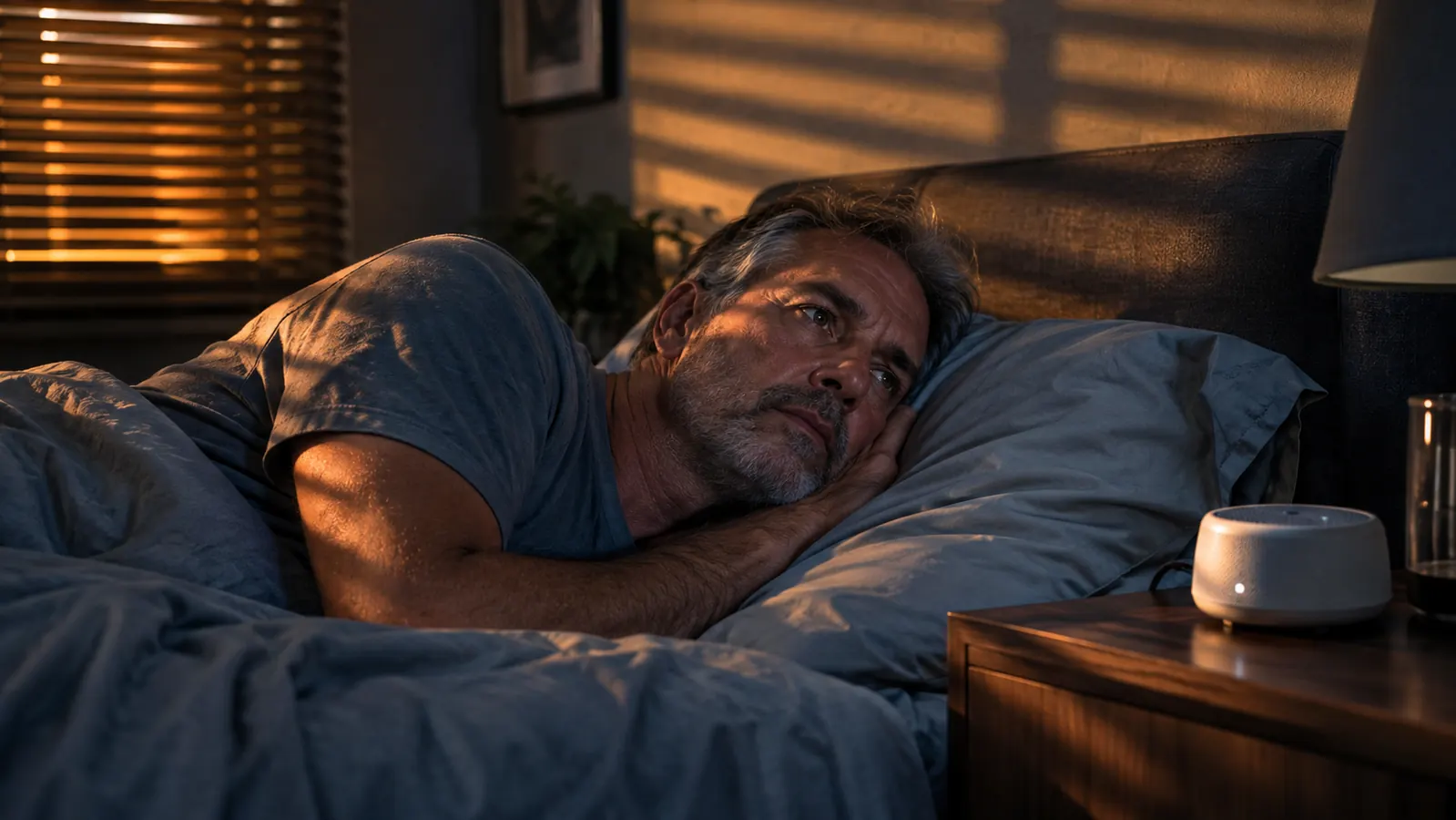
At 2:40 on a Tuesday morning, the streetlight across from our house throws four bars of light through the blinds, and one of them lands across my right eye. Not bright, exactly. Just there, the way a mosquito is just there. I used to lie still and catalog them: bar one on the ceiling, bar two across Linda's shoulder, bar three on the wall, bar four on my face. Then I would start doing math about how many hours were left before 4:45, which is the least useful math in the world.
The MZOO sleep mask was bought to end that specific argument, about two and a half years ago, after a few months of sleeping with a folded T-shirt over my eyes and waking up with it somewhere near my chin. I am 58. I supervise building maintenance at a hospital in Clifton, New Jersey, my shift starts at six, and my alarm goes off at 4:45 on weekdays. Every hour I lose to a stripe of municipal light is an hour I feel on a ladder at ten in the morning. So this is not a hobby review. It is the report of a man who needed the light gone.
The Quick Verdict
Two and a half years, one mask, no replacement. It kills the streetlight glare completely and keeps foam off my eyelids. The strap works loose about once a week and the foam needs most of a day to dry after the Sunday hand wash. For a light sleeper in a bright room, both of those are cheap trades.
Amazon Check Today's Price →The 2:40 a.m. stripe of light is gone. This is what removed it.
Contoured cups, 22mm of nose padding, and low-rebound memory foam that sits off your eyelids instead of on them. If a streetlamp is currently choosing your wake-up time, start here.
Amazon Check Today's Price on Amazon →How I've Used It
The mask lives on my nightstand on the street side of the bed, next to a white noise machine that has been running for three years, set to low. I put the mask on when I get into bed around 9:30, not when I wake up at 2:40 and get annoyed. I learned that the hard way. If I wait until I am already irritated, I am awake enough that nothing short of a brick helps, and the rest of the night is me lying in the dark being right about the streetlight.
The routine is unglamorous. Lights out, mask on, strap set, noise machine running. Linda reads on her side with a small clip light for twenty minutes or so. Before the mask, that clip light pushed me right out of the room, and I would lie there resenting a school librarian for reading in her own bed. Now I don't see it. That turned out to matter more to our evenings than the streetlight did.
I also use it for naps. A bad shift, a boiler that will not hold pressure, three hours of meetings about a roof, and I come home and lie down in the den for twenty minutes with the mask on. Midday sun comes straight through those den windows. Twenty minutes with the mask is worth forty without it, and because the cups sit off my eyes, I don't get up with that smeared, gritty feeling that makes a nap feel like a mistake.
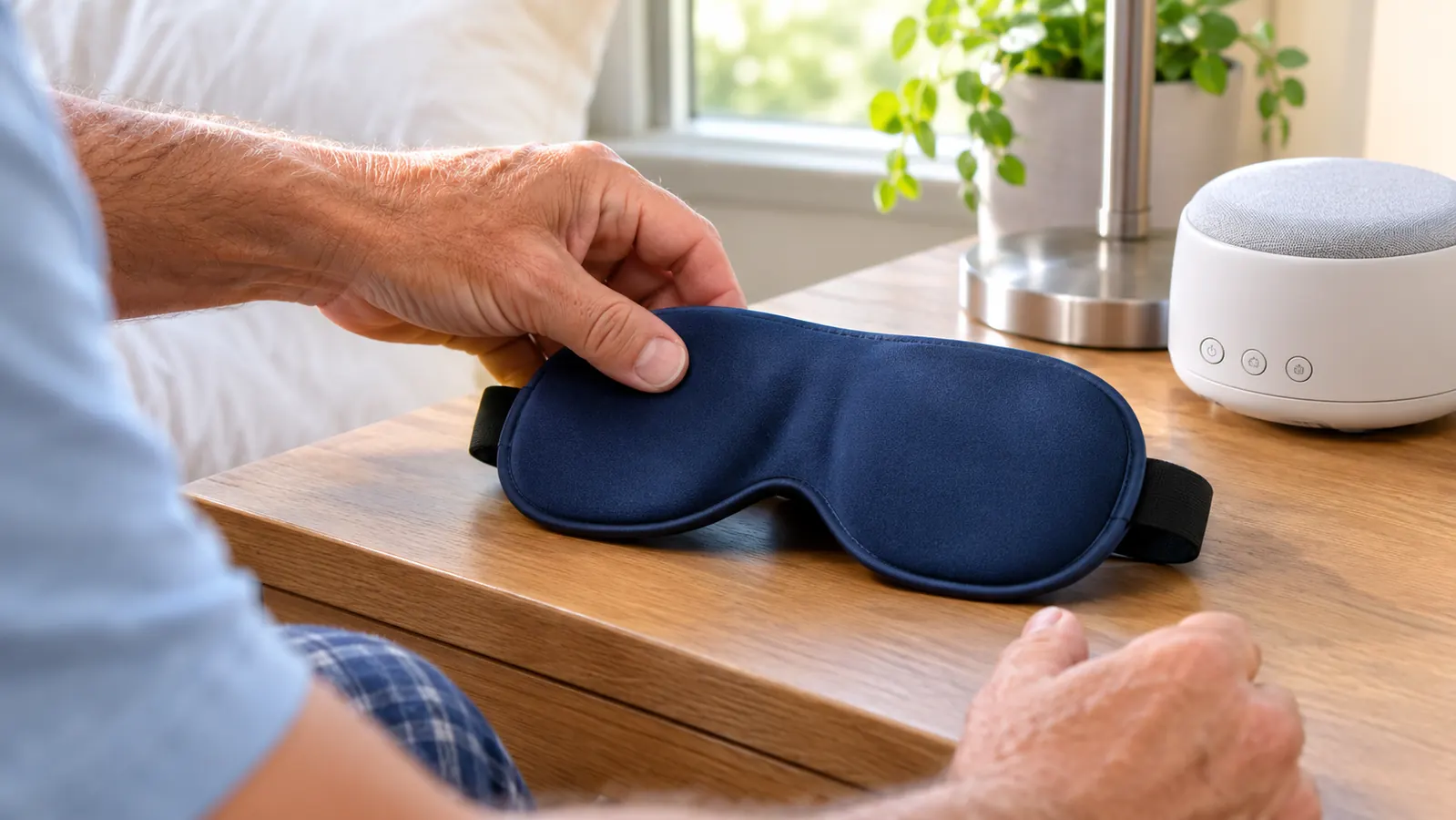
One more thing about the routine, because it took me a season to figure out. I keep the mask face up on the nightstand, cups toward the ceiling, so I am not fumbling with it in the dark at 9:30 and I am not putting it down on a dusty surface either. Small habit, but it is the difference between a two second motion and a small nightly negotiation with an object.
What the Contoured Cups Actually Do
The MZOO listing calls it a 3D contoured design. The number that matters is 13mm, which is how deep those arc-shaped, widened eye cups go. Deep enough that your eyelid can open and close without touching foam. I borrowed a flat drugstore mask from a hotel drawer once, and it pressed on my lash line all night. I woke up feeling like I had been crying. That never happens with this one, because there is nothing sitting on the eye itself.
The second number is 22mm of nose padding. Nose bridges are where flat masks leak. Every flat mask I have tried let a thin blade of light come up along the sides of my nose, and my brain would find that blade at 3 a.m. no matter how narrow it was. The padding on this one sits down over the bridge and closes the gap. That is the whole distance between dim and dark, and it is the reason the mask worked when the folded T-shirt did not.
Material is low-rebound memory foam, skin friendly per the listing, 10 by 3.9 by 0.78 inches at 5.11 ounces. Read that last number again, because it is the one I doubted before it arrived. Five ounces is light. The mask is a shell around your eyes rather than a pillow pressed onto your face, and after a couple of minutes you stop tracking it, which is not something I could say about the heavier mask my brother-in-law swears by.
The Side-Sleeper Question, Tested by Someone Who Rolls
I sleep on my right side, then roll to my back sometime in the last hour before the alarm. The sides of this mask are cut at a 15 degree curve and thinned down, which the listing says is for side sleepers. In practice that means when my cheek is on the pillow, the mask does not drive a hard edge into my temple. I have had that bruise-from-the-inside feeling from cheaper masks, the headache that shows up around 4 a.m. and makes no sense until you remember what is on your face. Not here.
It is not invisible, though, and I want to be straight about that because every review that skips this part is lying to you. The first three or four nights I was aware of it on my face and I slept a little worse. Somewhere around night five it stopped being an object and became part of going to bed. Two and a half years later I put it on without thinking about it, the same way I put my glasses on the nightstand.
The strap is adjustable with a buckle closure at the back. I set mine loose enough to slide a finger underneath, because a tight strap is how you get a mark across your cheekbones and a headache by morning, and a headache is a strange thing to pay for. It works loose over about a week of putting it on and taking it off, so I snug it back up most Sundays when I wash it. That is the entire maintenance story.
Worth saying plainly: this is one mask, one count, and the only fit adjustment is the strap. If you have a narrow head and a heavy hand with buckles, start looser than you think you need and live with it a night. I tightened mine too much the first week out of some instinct that a mask should feel secure, and I spent three mornings with a red line across my face.
Two and a half years, one mask, hand-washed every Sunday. The foam has not gone flat, the cups have not collapsed, and the only recurring chore is snugging the strap back up about once a week.
Wash Day, Which Is Sunday
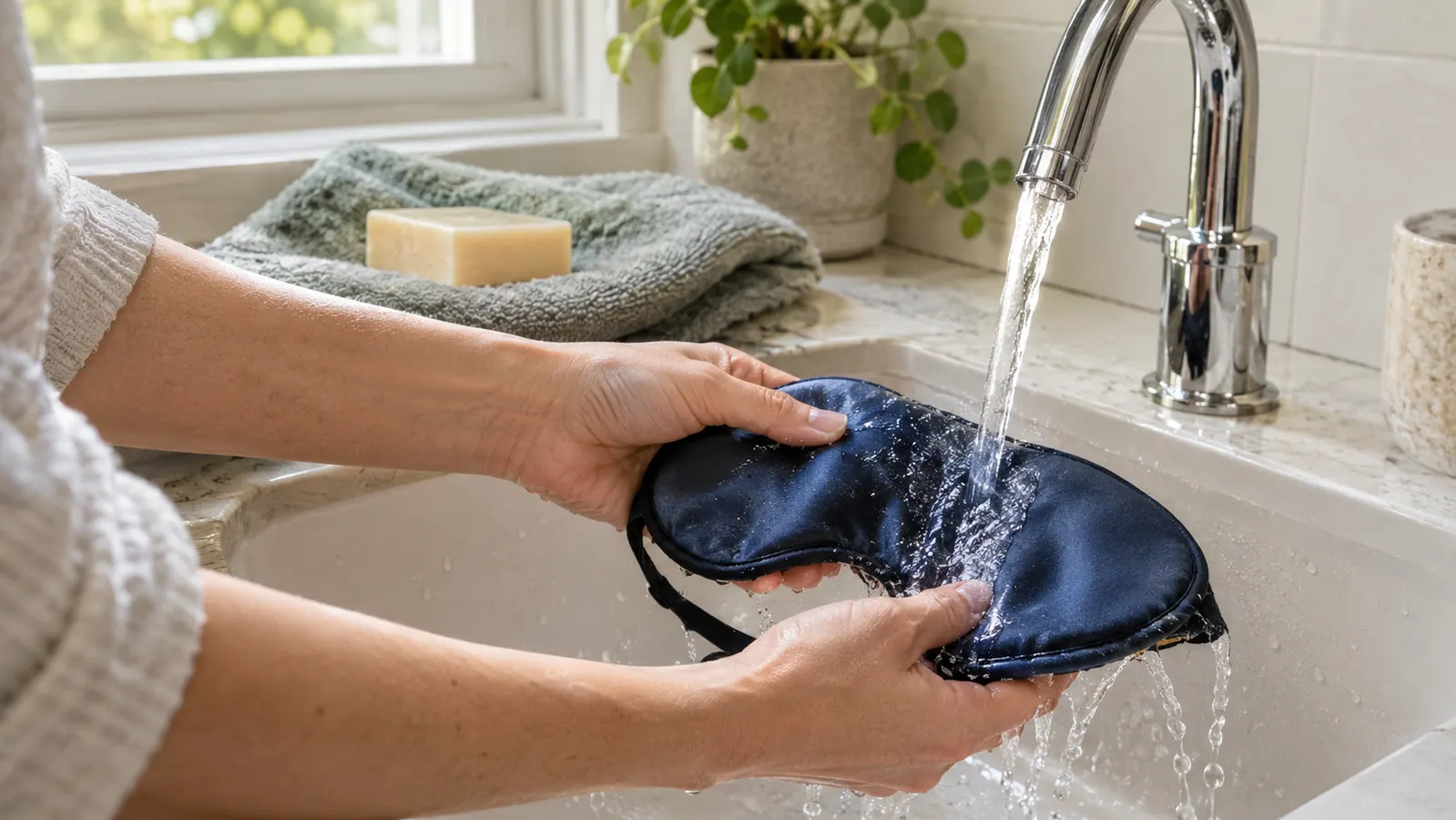
The care instruction on the listing is hand wash only, and after two and a half years I believe it. Anything that agitates memory foam breaks it down, and a mask that has lost its structure is just a strap with a rag on it. So: lukewarm water, a drop of mild soap, work it gently with my fingers, rinse until the water runs clear, press the water out with a towel instead of wringing it, and lay it flat on the counter.
Do that in the morning. The foam holds water and needs most of a day to air dry, so a Sunday night wash means a Sunday night with no mask, which for me means a 2:40 wake-up and a Monday on coffee. I learned that exactly once. In the hot weeks I also rinse just the inside of the cups with plain water midweek, since our bedroom runs warm in summer, and set it on the windowsill to dry while I am at work.
Linda tried it three or four times and handed it back. She rolls more than I do and she does not want anything touching her face, which is a perfectly good reason and not a knock on the mask. Her side of the bed runs warm, so we went the other direction with her pillow and left the mask as mine. One mask in this house, going on its third year, and it has outlasted two pairs of my work boots.
What It Does Not Fix
It does not block sound. The 5:15 bus comes down our street with a rattle in the rear axle and the mask has no opinion about it whatsoever. That is what the noise machine is for, and I would not give up either one. Mask for light, machine for sound. They cover two completely different problems and I have watched people buy one and expect the other to be handled.
It is also not a medical device, and it does not make you sleep. If your mind starts running at 2 a.m., a dark room will not stop it. That was a separate fix for me and it took a separate purchase, a weighted blanket I am still using eighteen months on. The mask removed an obstacle. It did not install an off switch, and any review that tells you a piece of foam does that is selling you something.
And if you snore loudly, or you wake up gasping, or you have caught yourself nodding off in a parked car, put the mask down and go get a home sleep test. I did one three years ago in our own living room. It ruled out apnea for me, which was a relief and also the start of taking all of this seriously. A mask is a tool for light. It is not a tool for a breathing problem, and no product on this page is.
What I Liked
- The streetlight glare is gone completely, including the leak flat masks leave along the nose
- 13mm contoured cups sit off the eyelids, so you can blink and open your eyes without hitting foam
- The 15 degree thinned sides do not dig into your temple when you sleep on your side
- Low-rebound memory foam has held its shape through two and a half years of nightly use
- 5.11 ounces is light enough that you stop noticing it after a few nights
- Adjustable buckle strap goes loose enough to leave no mark on your face
- A nap in a bright den actually feels like a nap
Where It Falls Short
- Hand wash only, and the foam needs most of a day to air dry
- The strap works loose and wants re-setting about once a week
- The first three or four nights you will be aware of it on your face
- It comes as a single count, so the strap is the only fit adjustment
- Does nothing for noise, which in my house is half the problem
Who This Is For
Light sleepers with a light problem. A streetlight, a partner who reads, a partner who scrolls, a hallway light somebody leaves on, sunrise at 5:20 in June. If the thing that wakes you is something you can see, this mask is aimed at you. Side sleepers especially, because that is where most masks fail, and I say that as someone who has woken up with a mask wedged against his nose at 3 a.m. Also anyone on a shift schedule who has to sleep in daylight, which is a specific kind of miserable and one I know from the nap side of it.
Who Should Skip It
If you cannot stand anything on your face, no amount of good design will change that, and Linda is the proof standing in my kitchen. If your problem is noise alone, spend your money on the noise. If you will not hand wash something once a week, the foam will tell you about it within a couple of months and you will blame the mask.
And if you have the symptoms I listed earlier, the loud snoring, the gasping, the nodding off in the car, see a doctor before you buy anything on this page. I mean that without a wink. The MZOO mask fixed my streetlight. It did not fix my sleep, and it will not fix yours either. It just takes one obstacle off the table so the other fixes have room to work, and after two and a half years I am still glad it is the one I picked.
Two and a half years on one mask. Let the sun come up whenever it likes.
Hand wash it on Sundays, snug the strap when it loosens, and stop negotiating with a streetlight at 2:40 in the morning. That is the whole program.
Amazon Check Today's Price on Amazon →