

I bought the YnM 15 lb weighted blanket about eighteen months ago, in the middle of a stretch where I was waking at 2 a.m. with a list of work orders running through my head. I am 58 and I supervise building maintenance at a hospital in Clifton, New Jersey. My shift starts at 6 a.m., the alarm goes off at 4:45, and I had run out of ideas that did not involve a prescription. What I wanted was something heavy enough to settle me back down after that 2 a.m. wake-up. What I got the first night was four hours of sleep and a sore shoulder. That is the honest starting point, and most of what follows is the part the product page leaves out.
Four nights in, I stopped noticing the weight and started noticing that I was falling back asleep instead of lying there doing arithmetic about the boiler room. So this is not a love letter. It is the version I would give a friend in the hospital parking lot. What the YnM blanket actually does for a bad sleeper, what it does not do, why my wife Linda will not go near it, and the six or seven weeks every summer when it lives on the cedar chest at the foot of the bed instead of on top of me. If you want the version with nothing negative in it, the product listing has that covered already.
The Quick Verdict
A genuine help for a racing mind on cool nights, provided you can handle the weight, the warmth, and a washing routine that needs a second pair of hands.
Amazon Check Today's Price →The weight that got me back to sleep at 2 a.m.
15 lb, 48 x 72 inches, seven layers, machine washable. It took me four nights to get used to it. That is the honest timeline, not a marketing one.
Amazon Check Today's Price on Amazon →How I've Used It, Night by Night
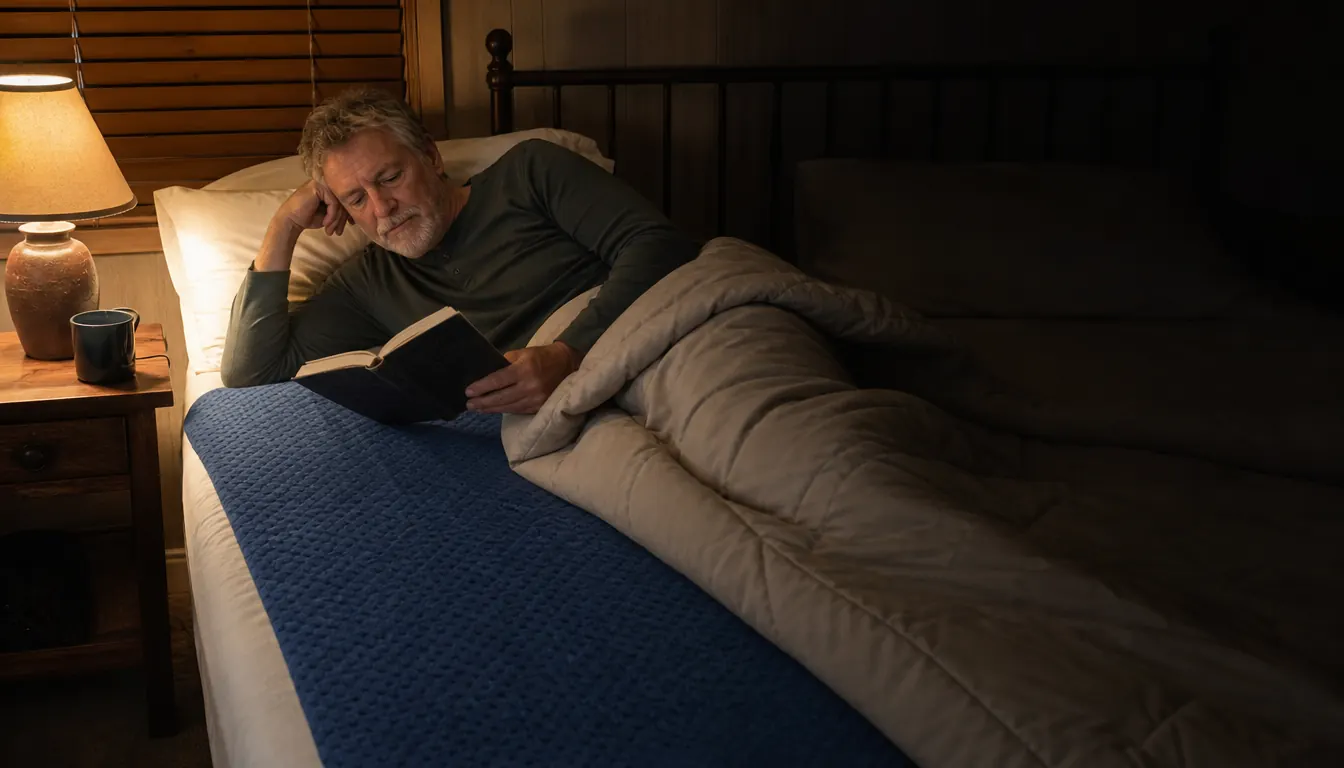
The blanket lives on my side of the bed only. Linda and I have shared one bedroom for a long time and we are well past the point of buying anything for that bed that both of us have to agree on. I lay the blanket over the sheet and under the comforter, roughly October through May. In the hottest weeks of July and August it comes off entirely and sits folded on the cedar chest at the foot of the bed, and neither of us pretends otherwise.
Before I bought it I tried the free version of this idea twice. First a heavy winter quilt folded double, which was warm and slid off in the night. Then a bag of rice my mother used to heat for a sore neck, which smelled faintly of rice for a week and held its heat for about forty minutes. Neither one worked. The useful part of a weighted blanket is that the weight stays put and stays cold, and a quilt and a rice bag do neither. I bought the real thing instead, and eighteen months later I would do it again.
The listing sizes it at 48 by 72 inches and 15 pounds, and it is clear that this is body-focused coverage rather than a bed drape. That matches what I found. It covers me from the shoulders to about mid-shin. If I pull it up to my chin, my feet are outside it. I solved that by wearing socks, which sounds ridiculous until you are the one doing it at 4:45 in the morning.
The first three nights were an argument. Fifteen pounds of polyester fill in a twill-woven microfiber shell does not drape so much as settle, and rolling over took actual effort. I woke up once with my left arm asleep underneath me and had to peel the whole thing back to get circulation going again. By the fourth night my body had stopped treating it as an obstacle. That is the timeline I would give anyone. Not one night. Not a week. Four nights, and two of them were unpleasant.
The Weight Is the Whole Story
Fifteen pounds is not much in the abstract. It is a great deal when it is spread across your chest at 2 a.m. The first thing to understand is that the weight is distributed rather than concentrated, and that distribution is the entire reason the blanket does anything at all. YnM sews the fill into 2 inch by 2 inch compartments, the smallest grid I have come across in this category. The practical effect is that when you shift position, the fill does not slide to one end and dump fifteen pounds onto your hip. I tested that by accident more than once.
The other decision is the size and the weight together, and they are not separate choices. The guidance that worked for me is the one that puts the blanket at roughly a tenth of your body weight. I am about 165 pounds, which puts 15 pounds close to the mark. A heavier blanket would stop being a comfort and start being a task, particularly on the nights I get up to check the boiler alarm in the basement. The 48 by 72 dimension is the other half of it. Anything wider and it would have crossed onto Linda's side of the bed, and she would have felt every ounce of it through the sheet.
The second thing is that the quilting makes it stiff. A blanket with larger pockets folds and drapes. This one holds its shape, which is good on a flat mattress and less good when you want to tuck it around your shoulders on the couch. I tried it on the sofa for a Sunday nap twice and gave up both times. It is a bed blanket. Treat it as one and you will not be disappointed.
YnM's own guidance is that this size suits one adult, and that is worth repeating, because the most common mistake I hear about is two people buying one blanket and fighting over it all night. Fifteen pounds split between two adults is seven and a half pounds each, which is close to nothing. If Linda ever wanted one, she would need her own, and she does not, so we are fine on that front.
Four nights of rolling over like a man in a sleeping bag, and then the weight stopped being the obstacle and became the reason I stayed asleep.
It Sleeps Warmer Than the Listing Suggests
The listing says all seasons and describes the fabric warmth as lightweight. I would push back on that. The shell is 100 percent microfiber and the fill is polyester, and both trap heat. The weave is twill, which is tighter than a plain weave and does not breathe as freely. Linda runs warm at night and would not sleep under it in any month of the year. I run neutral to cool and I am comfortable October through May with the ceiling fan on low.
From roughly mid-June to the end of August, the blanket comes off my side of the bed entirely. Our bedroom is on the second floor of an older split-level and the central air does not quite reach it during a heat wave. Under fifteen pounds of polyester in that room, I would wake up damp. I tried it once in July out of pure stubbornness and lasted about two hours before I moved it to the chest.
There was a night in early September, the second week of the month, when the temperature outside never dropped below seventy and our bedroom held every degree of it. I had the blanket on out of habit and the ceiling fan on high. By 1:30 I had thrown it off, and by 2:00 I was awake anyway, which is the point. A blanket that traps heat does not just make you warm. It makes you wake up to get away from it. Since then I have had a rule: if the overnight forecast is above 68, the blanket goes on the chest before I get into bed. No negotiating at 2 a.m.
So the honest framing is seasonal, not year-round. It is a three-season blanket in a house with decent air conditioning, and a two-season blanket in a house without it. If you keep your bedroom at 68 degrees or below in summer, you will probably be fine. If you sleep hot in general, this is probably not your blanket, and no amount of copy on the listing changes the physics of polyester. I keep a cheap thermometer on the nightstand now, mostly so I stop arguing with myself about whether the room is actually warm.
What I Liked
- Fifteen pounds spread evenly, with 2 x 2 inch compartments that keep the fill from sliding to one side
- Seven-layer build with a twill microfiber shell, so it does not feel like a plastic sack under your hands
- Machine washable, and it came out of a front loader without clumping
- Sixteen sewn loops around the edge, so a duvet cover will actually stay put if you buy one
- It genuinely helped me get back to sleep after a 2 a.m. wake-up
Where It Falls Short
- Four nights of adjustment, and I nearly quit on night two
- Warmer than the listing implies, and unusable in an uncooled bedroom in July
- Stiff enough that it works on a bed and poorly on a couch
- Fifteen pounds is a real load to carry, and machine washing needs a large drum
- Linda could not use it at all, and this size is not built to be shared
Washing It Is a Two-Person Job
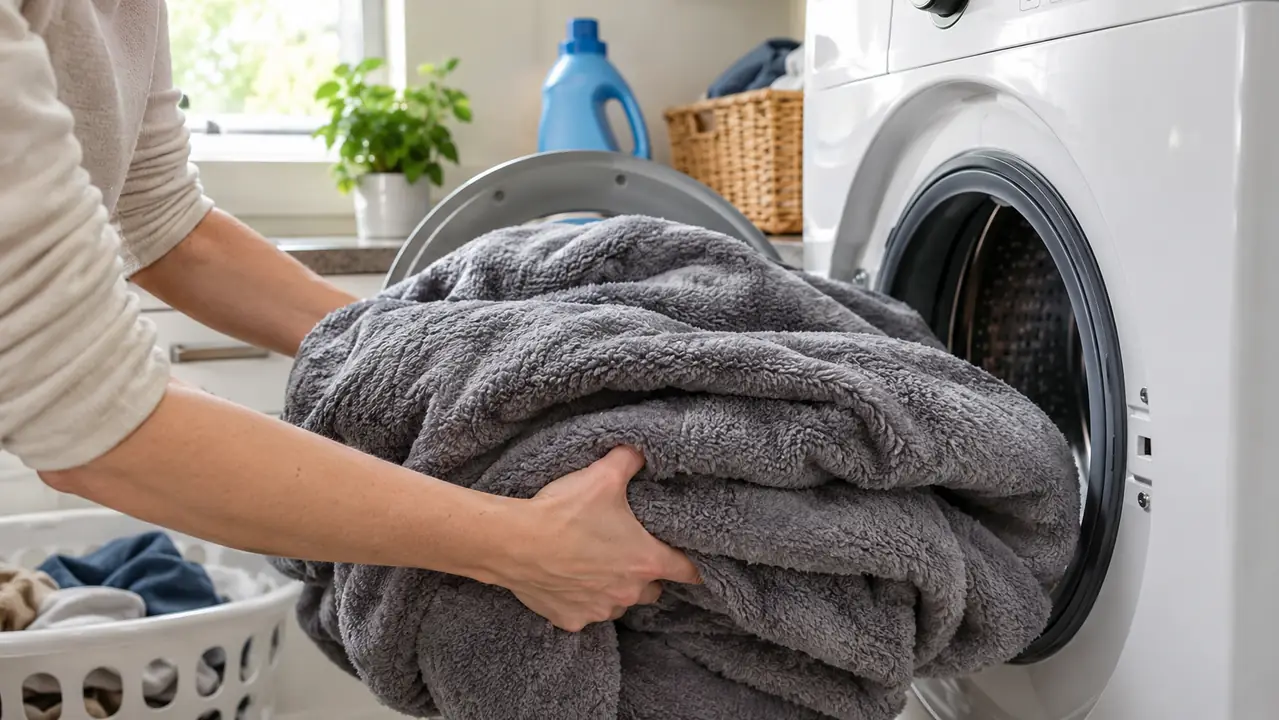
The care instructions say machine wash, and that is true, with an asterisk. A 15 pound blanket is a lot of wet fabric. Ours is a front loader with a large drum and it handled the blanket on a cold, gentle cycle without complaint. The fill did not clump and the compartments held their shape. But getting the blanket into the drum, and then getting it back out and into a dryer, is a two-person job in this house. Linda holds the door and I do the lifting.
The first wash was in November, on a Saturday, and it took most of the afternoon. Cold water, gentle cycle, a half cup of mild detergent and nothing else, because I did not want to find out what fabric softener does to polyester fill. The machine spun it longer than I expected and it came out heavier than it went in. From the washer to the dryer I carried it in both arms like a rolled carpet. Two low cycles, forty minutes each, with a hand redistribution at the halfway point, and it was dry at the corners and faintly damp in the middle of the compartments.
Drying is its own project. Dry it on high and you are asking for clumped fill and a hot spot in the middle. Our dryer is nothing special, a mid-size electric unit from the same decade as the house, and it coped, but it needed the full time. I also would not put it in a small apartment dryer, because it needs room to tumble. My routine is two washes a season, one in late fall and one in early spring, plus a spot clean if something lands on it.
The sixteen loops around the edge are there so you can tie on a duvet cover, which YnM sells separately. I have not bought one. The microfiber shell wipes down easily enough and I did not want another layer of fabric over a blanket that already runs warm. If you sleep cool and want to keep it clean without washing as often, a cover makes sense. If you sleep warm, it is one more thing holding heat against you.
What It Does Not Do
It does not fix a bad schedule. I still get up at 4:45 and I am still tired by Thursday afternoon. What the blanket changed was the middle of the night, not the end of it. The 2 a.m. wake-up still happens maybe twice a week. The difference is that most nights I am back asleep in ten minutes instead of lying there for an hour and a half doing inventory on my own life.
It does not work for Linda. She tried it for about twenty minutes one night in November, said it felt like being sat on, and handed it back across the bed. She is a light sleeper who runs warm and she has her own setup, a shredded foam pillow she has adjusted twice. If your partner is the one with the racing mind and you are the one who sleeps fine, buy one blanket, not two, and do not assume it will be shared.
And it is not a medical device. If you snore loudly, wake up gasping, or find yourself falling asleep in the car in the middle of the day, a weighted blanket is not the answer to that. I nodded off in the hospital parking lot before a shift about three years ago and my doctor sent me for a home sleep test. It came back clear, which is how I ended up working on this bedroom one change at a time. If you have not had that conversation with a doctor, have it before you spend anything on sleep gear.
Who This Is For
This is for a person who lies awake with their mind running and wants something physical to interrupt it. It is for someone who sleeps in a cool room, who does not have to share the blanket, and who is willing to give it four nights before making a decision. It is also for someone who reads the weight guidance and picks a size that matches their body weight rather than grabbing the heaviest one on the page. Ten percent of body weight is the usual starting point, and 15 pounds lands about right for a man in the 150 to 170 pound range.
It suits a bed, not a couch. It suits a person who does not mind a slightly stiff blanket and who has a washer with a big drum and a dryer that can tumble it. And it suits someone who wants a one-time purchase rather than a device that needs charging or a subscription that renews. There is nothing to plug in here, nothing to sync, nothing to update. That was a good part of the appeal for me at this point in my life.
Who Should Skip It
Skip it if you sleep hot. Skip it if your bedroom runs warm in summer and you do not want a blanket that spends two months folded on a chest. Skip it if you have trouble moving around in bed, or if you have any condition where weight across your chest or legs is a problem. Ask your doctor about that rather than a review, including this one. And skip it if you want a single blanket for two people, because this size is not built for that and fifteen pounds divided in half is not a weighted blanket anymore.
Skip it too if you want an overnight fix. Four nights of adjustment is not long, but there were two of those nights when I would have quit if the thing were not already out of the box and on the bed. That is my honest read after eighteen months of sharing a bed with it. It helps. It is not a cure, and it is not for everybody, and the distance between those two statements is the whole review.
Eighteen months in, it is still on my side of the bed
Not every night. Not in July. But most nights from October through May, and that is more than I can say for anything else I have bought for this room.
Amazon Check Today's Price on Amazon →