
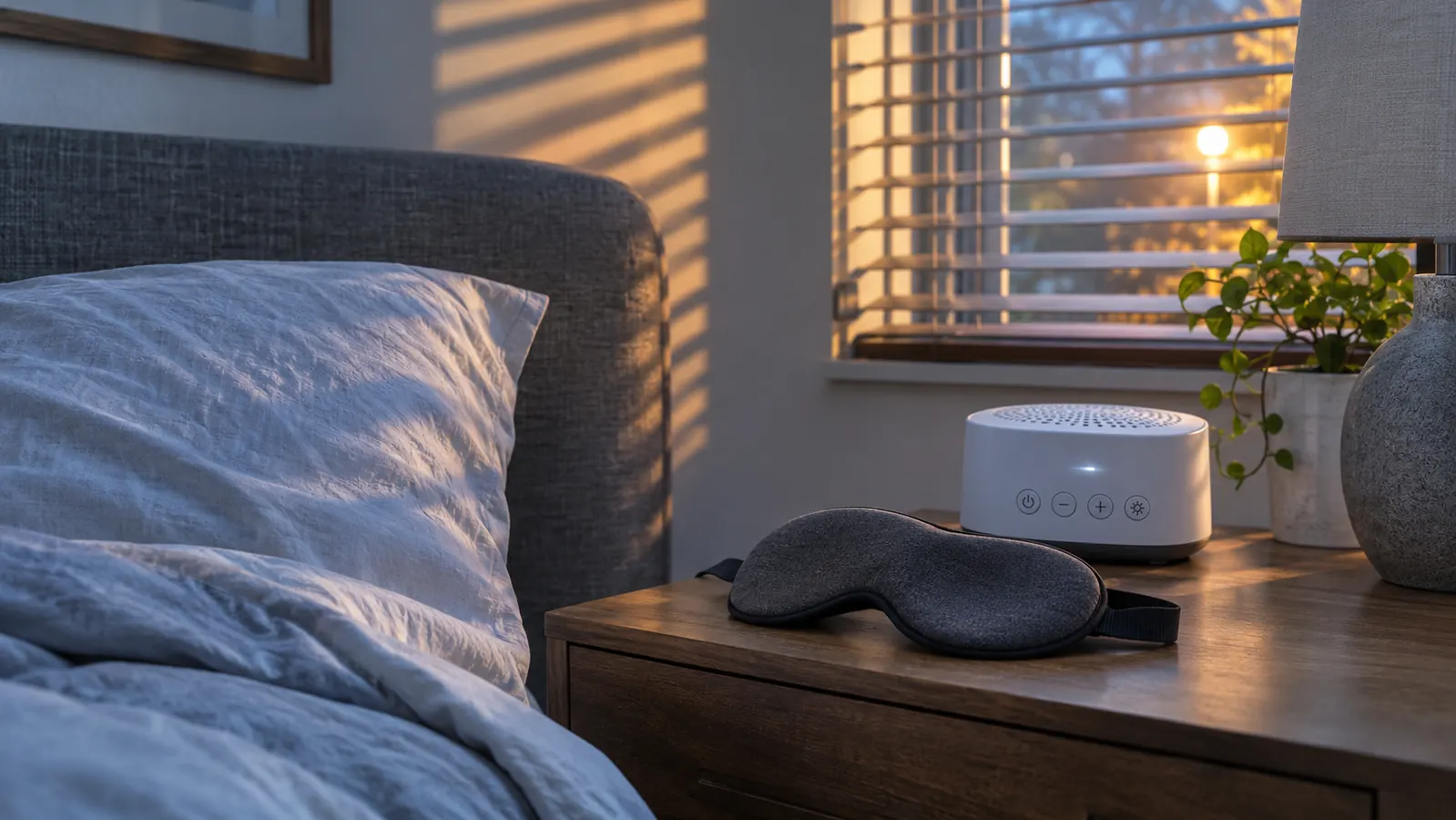
At 2:40 on a Tuesday morning, the streetlight across from our bedroom found the one gap in the blinds and landed directly on my pillow. I know the exact time because I looked at the clock after twenty minutes of trying to pretend it was not there. Our bedroom faces a bus route in Clifton, New Jersey, and the light comes through in a thin white stripe that seems brighter at night than the sun does at noon. I am Frank Moretti, fifty-eight, a maintenance supervisor at a hospital. I have spent most of my adult life treating sleep like something that happens if I lie still long enough. It does not. The change that made the biggest difference was not a new mattress or a stricter bedtime. It was a contoured sleep mask from MZOO, fitted properly, plus a handful of habits around it. This is how I use one to sleep through streetlight glare without turning the bedroom into a cave.
I am not going to pretend a mask solves everything. Linda, my wife, is a lighter sleeper than I am, and she does not wear one. She solved her side of the room with a pillow that stays cooler and a white noise machine we both use. My side needed blackout at the eyes, not just at the window. Blinds help, but they leak. Curtains help more, but they take more work to hang and still leave the edges. A mask sits on your face, which means it travels with you to a hotel, a nap on the couch, or a 5 a.m. summer sunrise. The MZOO mask is the one I landed on about two and a half years ago, and it is still the one on my nightstand next to the Dohm.
The gap in the blinds is not the problem. The light reaching your eyes is.
A contoured mask with an adjustable strap and deep nose padding seals around the eyes, not on them. That is the job. Everything else is fit.
Amazon See the MZOO sleep mask on Amazon →Step 1: Find the light path before you buy anything
Before I bought a mask, I did something that felt silly and turned out to be useful. I stood in the bedroom at 2 a.m. with the lights off and followed the light with my hand. The streetlight came through the left edge of the blinds, hit the wall above the headboard, and dropped onto my pillow. That is a light path. If you lie in bed and look around, you will find two or three paths in most rooms. One comes from the window. One comes from a clock, a charger, or a smoke detector. One comes under the door from the hallway. Do this before you buy anything, because the fix for each path is different.
The streetlight was not my only leak. The cable box put a small blue dot on the ceiling. The smoke detector blinked every thirty seconds. The hall nightlight sent a yellow line under the bedroom door. I fixed the cheap ones with electrical tape and a folded towel at the door. The remaining stripe was the one that hit my eyes. That is the one a mask can handle. If light lands on your forehead or cheek, a wide seal can cover it. If it comes from behind your head, no mask will help until you move the curtain or turn your body. I learned that the hard way on the first night.
Write down the three brightest spots and what time they show up. Mine were the gap at the left edge of the blinds, the clock radio, and the sliver under the bedroom door. Only one of them needed the mask. The other two needed ten minutes and a roll of tape. Start there. It is easier to fit a mask when the room is not fighting you from four directions.
Step 2: Fit the mask so it seals, not squeezes
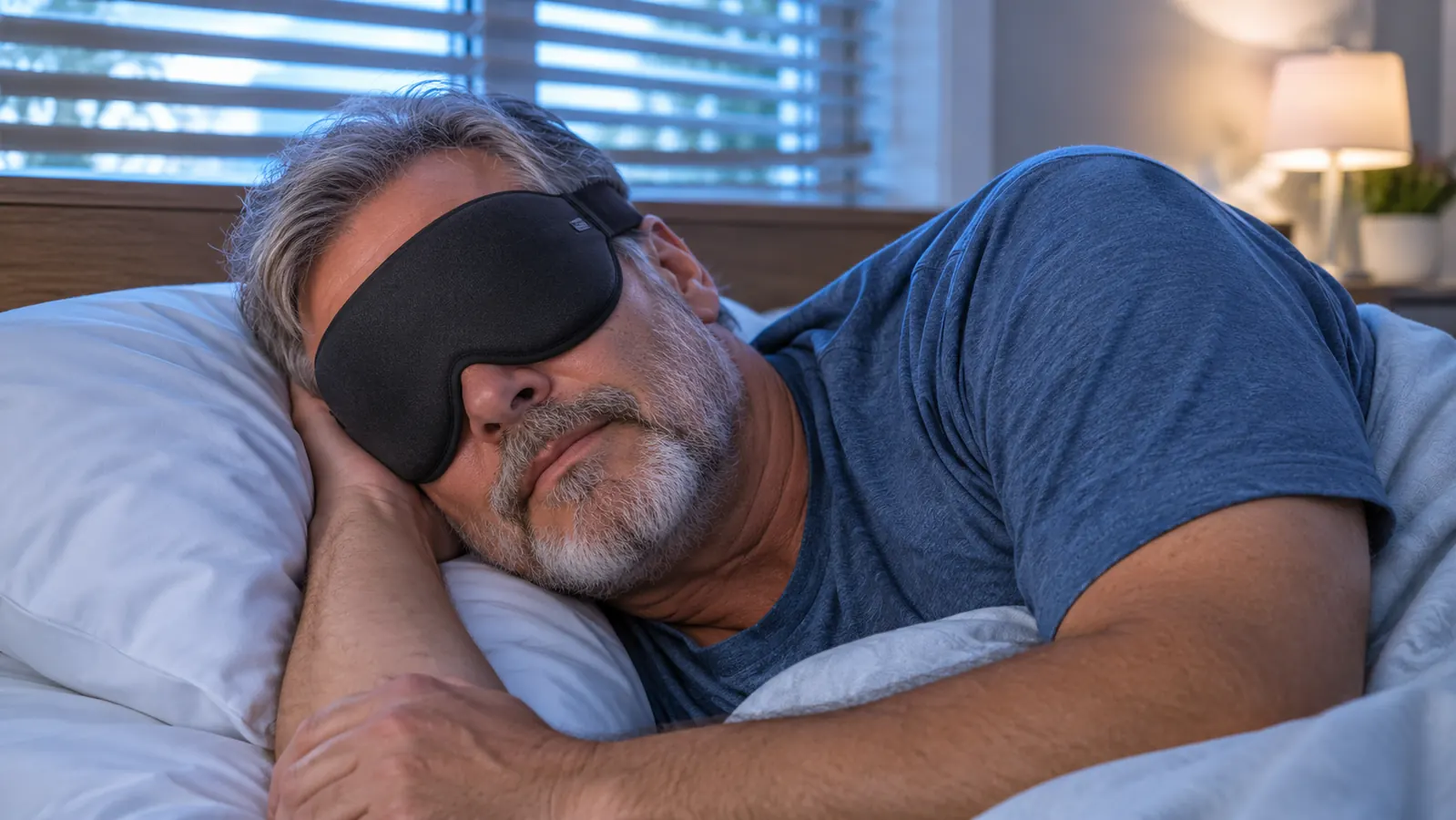
The MZOO has a buckle closure and an adjustable strap. That sounds simple. It took me three nights to get right. The strap should be snug enough that the mask does not slide when you turn, but loose enough that you can blink without feeling the eye cups press on your lashes. The listing calls the eye cups 13mm deep and arc-shaped, and the nose padding 22mm deep. What that means in practice is that there is room around your eyes. The seal happens at the edges, not on the eyeball. If you tighten it until it hurts, you will take it off at 3 a.m. and blame the mask.
Start with the buckle at the back of your head, not over your ears. Put the mask on, lie down in the position you actually sleep in, and check for a light stripe. For me that is on my left side, facing the window. The first fit felt fine standing at the bathroom mirror and leaked like a screen door when I lay down. Gravity moves the mask. Fit it lying down. Then turn to your other side and check again. If it leaks on one side and not the other, adjust the strap by a quarter inch, not an inch.
The nose padding is the part most people skip. If the mask sits too high, light comes in under the eye cups. Too low, and it presses on your nose. I set the bottom edge just above the bridge, then pull the top strap down a hair. The 15-degree curved sides are supposed to keep the mask from bulging into the pillow when you are on your side. I still feel it against the pillow. It is thin enough that it does not wake me, but it is not invisible. If you are a strict face-down sleeper, this may not be your mask.
Step 3: Give it a week before you decide
The first night I wore the MZOO mask, I hated it. I was aware of the strap. I could hear my own breathing. I took it off at 3:15 and put it back on at 3:20 because the streetlight was worse. The second night was better. By the fourth night I was putting it on without thinking. That is the timeline I would give anyone: four nights to stop noticing it, a week to know if it works. If you have a bad first night, do not throw it in a drawer. Give it the week.
A mask is a small change, and small changes are easy to abandon on a bad night. Do not judge it after one hot, restless night. Judge it after seven nights in your own bed, with the same pillow and the same room temperature. I also stopped drinking a full glass of water after 8 p.m. during that week, which cut my 2 a.m. bathroom trip. That had nothing to do with the mask, but it made the week a fair test. If you change four things at once, you will not know what helped.
One practical note: the MZOO is hand wash only. I wash mine on Sunday mornings in a sink of cool water with a drop of mild soap, rinse it, and press it between two towels. It dries by the afternoon. I do not put it in the washing machine, and I do not wring it out. The memory foam is the reason. If you throw it in with the sheets, you will get a lumpy mask and a bad week. A clean mask also seals better, because skin oil and pillow dust keep the edges from sitting flat.
Step 4: Fix the sound and the temperature, too
Light was only half of my problem. The bus route starts at 5:10, and the first bus is loud enough to rattle the window. The Dohm white noise machine sits on my nightstand about three feet from the bed, on the low speed with the collar turned halfway. It runs all night. Linda stopped noticing it after about a week. I notice it when the power goes out, because the room suddenly sounds like a bus depot. If you are waking to traffic, a mask will not fix that. You need sound, or earplugs, or both.
Temperature is the other half. Linda runs warm, and she switched to a shredded memory foam pillow about two years ago. She took some of the fill out the first week to get the height right and keeps the extra in a zip bag in the hall closet. I kept my old pillow. I also use a 15-pound weighted blanket in the cooler months, over the sheet and under the comforter, on my side only. It took me four nights to get used to the weight. In the hottest weeks of July and August, it is folded on the cedar chest at the foot of the bed.
You do not need all of this to block a streetlight. But if you are waking at 2 a.m. and lying there, light might be the smallest part of the problem. A mask helps with light. It does not cool a warm room, muffle a bus, or quiet a mind that is replaying a conversation from work. I fixed those one at a time, over about three years. The mask was one piece. The white noise was another. The cooler pillow, the blanket, and the earlier bedtime came later.
Step 5: Protect the last hour before your alarm
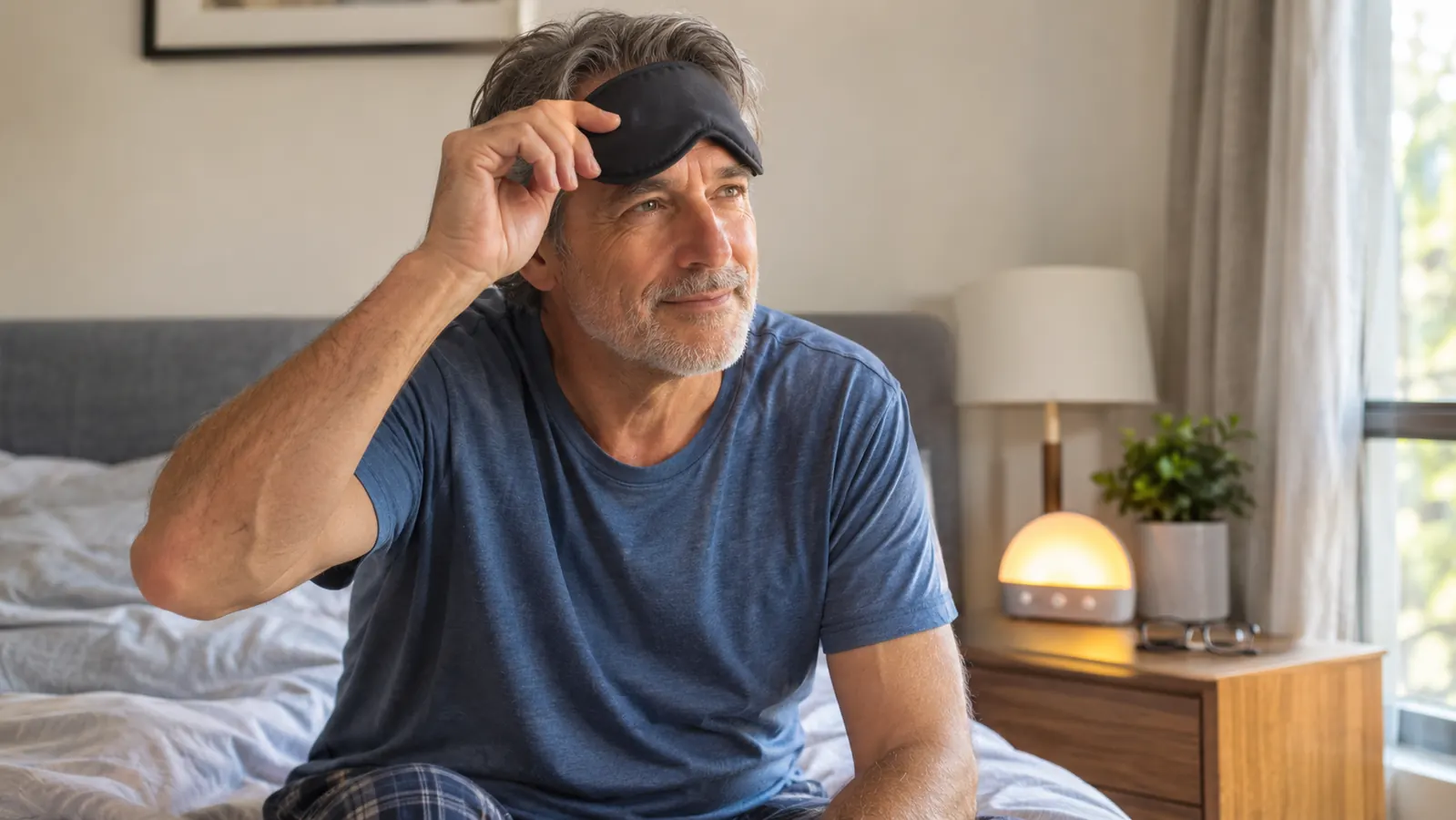
My weekday alarm goes off at 4:45. For years I used the phone, which meant I was looking at a bright screen the second I woke up. A year ago I switched to a sunrise alarm clock on my nightstand, on the side away from the Dohm. It starts a 30-minute sunrise before 4:45 and ends with a soft sound. Linda sleeps through the light most mornings because of where it faces. The point is not the gadget. The point is that I am not shining a phone in my face at 4:45 and then wondering why I feel like a parked car.
The mask stays on until the sunrise is bright enough that I can tell it is working. Then I take it off, sit up, and put my feet on the floor. I do not check email. I do not check the weather. I do not look at the news. That sounds small. It is the difference between starting the day with my own thoughts and starting it with someone else's emergency.
On the days I come home and need a nap, I put the mask back on for twenty minutes in the recliner. It is the same mask. I do not have a second one. That is the other thing I would tell you: keep it simple. One mask, one hook on the nightstand, one wash day. If you have to hunt for it at 2 a.m., you will not use it. The best sleep tool is the one you can find in the dark.
The first fit felt fine at the bathroom mirror and leaked like a screen door when I lay down. Fit it lying down.
What Else Helps
Blackout curtains are the obvious first move, and they are worth it if you own your home or can put them up without losing a deposit. I used a tension rod and a heavy curtain for two years before the mask. It cut the streetlight by maybe 70 percent. The remaining 30 percent was the stripe that hit my eyes. The mask handled that. If you are starting from zero, do both: darken the window, then seal the eyes. The order matters less than doing both before you decide sleep is broken.
A white noise machine or a fan helps with the bus and with a partner who snores. I snored for years. Linda used earplugs and a fan. I finally got a home sleep test about three years ago, and my doctor ruled out sleep apnea. If you snore loudly, wake up gasping, or fall asleep in the car, get the test. A mask is not a treatment for apnea. It is a tool for light. That is a small but important line, and I wish someone had said it to me ten years ago.
If you are awake for an hour or more most nights, or you are tired enough that you nod off in a parking lot before a shift, talk to your doctor. I did. That is how I ended up with the sleep test and a plan. I am not a doctor. I am a maintenance supervisor who got tired of being tired. The MZOO mask is one change that helped me. It is not a diagnosis, and it is not a substitute for one.
Block the stripe, not your whole morning.
The MZOO mask has a contoured seal, an adjustable strap, and deep nose padding. If streetlight is the last thing keeping you up, start there.
Amazon Check the MZOO mask on Amazon →