
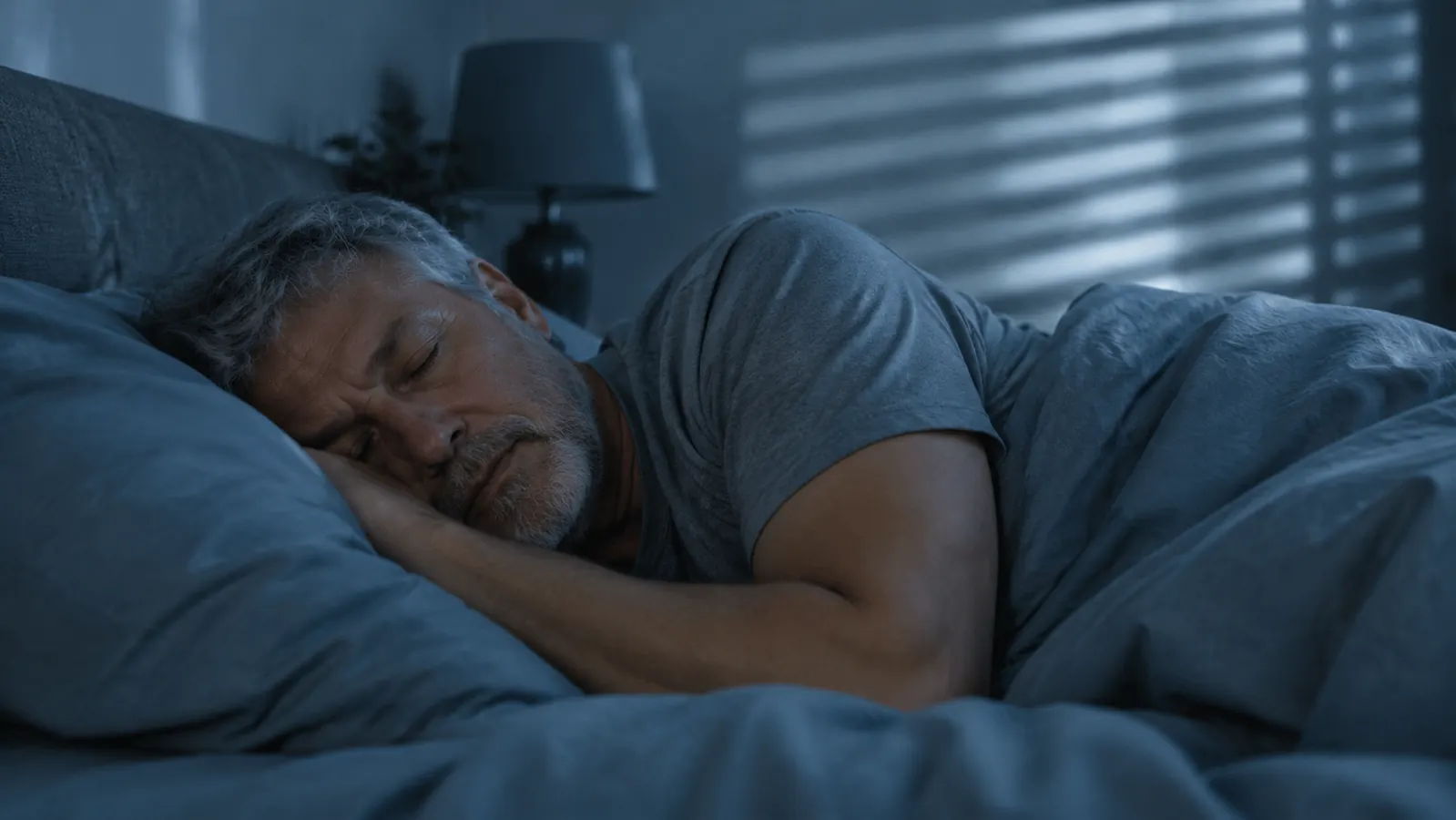
Two and a half years ago I bought the MZOO contoured sleep mask for one reason: the streetlight outside our bedroom in Clifton, New Jersey, hits the blinds at exactly the height of my eyes. I am Frank Moretti, I am 58, I supervise building maintenance at a hospital, and my weekday alarm goes off at 4:45 in the morning. Lying there at one in the morning watching an orange stripe crawl across the ceiling was not a schedule I could keep. What follows is the review I wish somebody had handed me before I clicked buy: what the MZOO mask genuinely does well, the things about it that irritated me for the first month, and the kind of sleeper who should not buy it at all.
Most reviews of this mask read like the product page rewritten in the first person. This one is not going to. I own exactly one mask. I have washed it by hand every Sunday since the week I bought it. It lives on my nightstand next to a white noise machine that runs from lights out to morning. That is my entire test sample: two and a half years of nights, two and a half summers in a bedroom that runs warm even with central air, a couple of head colds, and a stretch of overtime where I was sleeping in daylight. No lab. No panel of volunteers. Just a man in his late fifties with a bus route outside his window and a wife who wakes up if a drawer closes too hard.
The Quick Verdict
Blocks light better than any flat mask I have owned, and the eye cups genuinely keep pressure off your eyelids. It loses points for the hand wash only care, for a strap that took me a week to dial in, and for how warm it gets in July.
Amazon Check Today's Price →The stripe of streetlight on my ceiling is gone. Here is what the mask costs today.
Complete blackout, 13mm contoured eye cups, and 22mm nose padding that closes the gap flat masks leave open. If your bedroom is never truly dark and you sleep on your side, start here.
Amazon Check Today's Price on Amazon →What Nobody Tells You Before You Buy a Contoured Mask
Here is the thing the bullet points leave out. Light does not get into your eyes through the fabric of a sleep mask. It gets in around the edges, through the gap at the bridge of your nose and the gap under your lower lashes when you blink. A flat silk mask can be as thick as a folded towel and you will still see a glow at the bottom of your vision, because the material lies on your eyelashes and lifts every time your eyes move. The MZOO mask solves that by not touching your eyelids at all. The eye cups are 13mm deep and arc-shaped, so there is actual empty space over each eye, and you can open your eyes and blink inside the mask without the fabric dragging across your lashes.
That sounds like a small thing until you have worn it. With a flat mask, every blink pulls at the fabric, and by 3 a.m. the band has slid up your forehead and you are staring at the ceiling again. With this one the seal sits on the bone around your eye socket, not on the eye itself. The padded area at the nose is 22mm deep, and that number matters more than anything else on the listing if you have any kind of bridge on your face. That padding is what kills the last sliver of light coming up from under the blinds. I noticed the difference on the first night, which almost never happens with sleep gear. Usually I need a week before I can tell whether something is helping or whether I just want it to.
The mask is memory foam, listed as low-rebound, and it weighs 5.11 ounces. That is heavier than silk and you feel it for the first few nights. Low-rebound means it presses back slowly instead of springing, so it settles against your face rather than fighting it. The whole thing measures 10 by 3.9 by 0.78 inches, so it is a piece of gear, not a handkerchief. If you are picturing something you can fold into a shirt pocket, you are picturing the wrong product.
How I've Actually Used It for Two and a Half Years
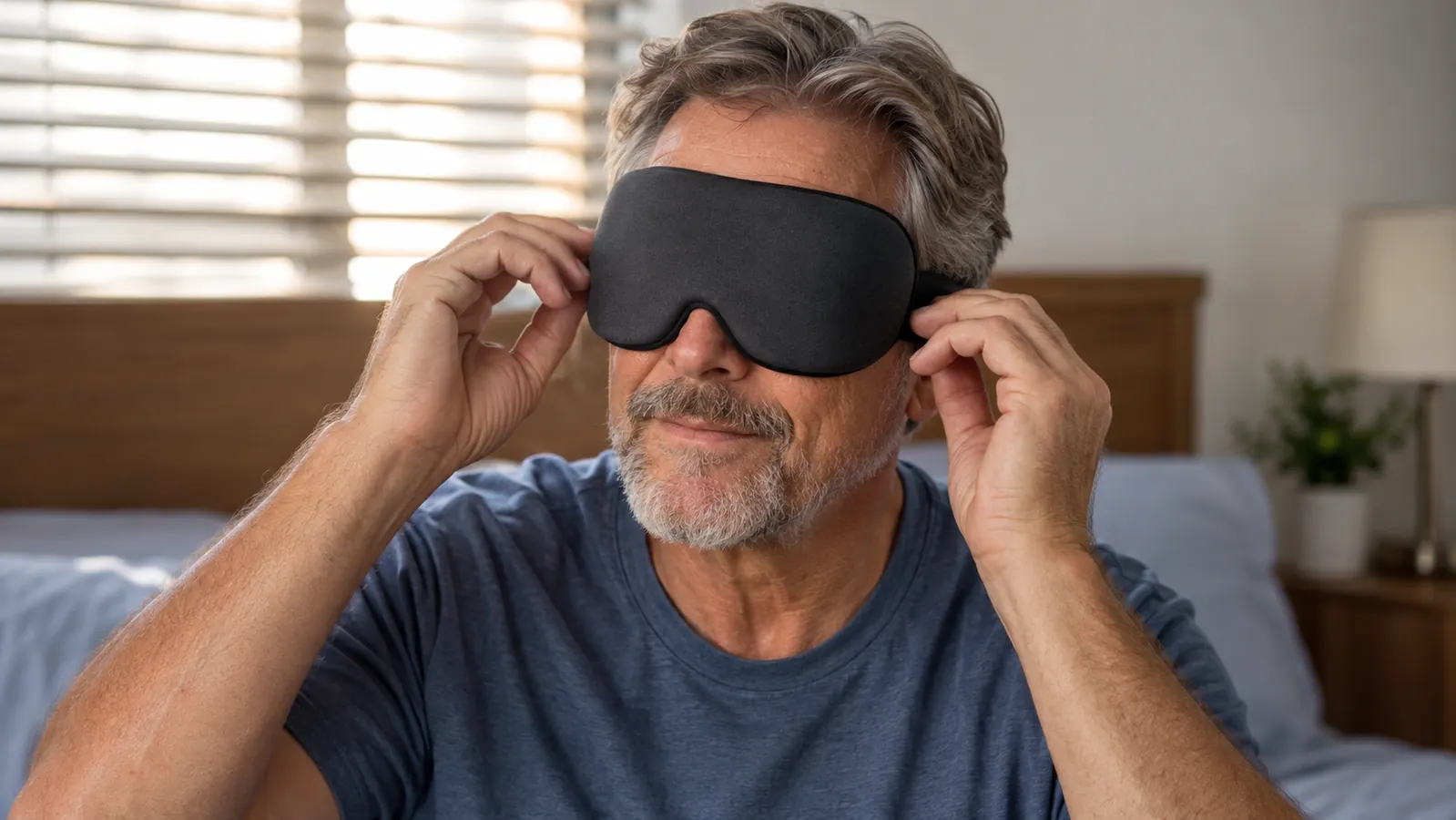
My routine is boring and that is the point. Around 9:15 I turn off the lamp, start the white noise machine, put the mask on, and that is the end of my involvement. It does not need charging, it does not need an app, and it does not need me to remember anything. It sits on the nightstand where I left it. The only maintenance is the washing, which gets its own section below, because it is the single biggest annoyance of owning this thing.
The other use I did not expect is the nap after a hard shift. I work early, so a bad night means I am home by mid afternoon with daylight coming through every window in the house. Twenty minutes on the couch with the mask on is the difference between being useless at dinner and being a person. I have done that maybe a hundred times in two and a half years. It works because the mask blocks light from the top and the sides, not just straight ahead.
Winter is the test I did not plan for. From November through February my 4:45 alarm goes off in a room that is completely black, and about a year ago I added a sunrise alarm clock that ramps up over half an hour so I am not waking to a buzz. The mask comes off once the light is already climbing, which is a gentler start than ripping it off in the dark. On mornings I forget to set the sunrise, I am still in the mask when the alarm sounds, and I have gotten good at finding the buckle behind my head without pulling the whole thing off. Small thing. It matters at 4:45.
Light does not come through the fabric. It comes around the edges, and the 22mm nose padding is what closes the last gap.
The Parts That Genuinely Work
Blackout is the headline and it holds up. My bedroom is not a cave, but it is not dark either. There is a streetlight maybe forty feet from the window and a bus that runs until midnight. With the MZOO mask on I see nothing. Not a glow, not a shape, not the difference between my hand in front of my face and the ceiling. The listing calls it complete blackout, and after two and a half years I would not argue with the wording.
I sleep on my right side most of the night, and that is where most masks fail me. A thick mask presses into the pillow and gets shoved up over your ear by 2 a.m. The sides of this one are cut thin and curved at 15 degrees, so there is no bulge digging into the pillow or your temple. I still get a faint seam mark on my cheek some mornings if I have been pressed into the pillow for hours, but the mask stays where I put it. That is the difference between a mask you wear and a mask you fight.
The seal also survives rolling over, which I did not believe until I had tested it a few dozen times. I start on my right side and usually end up on my left, and somewhere in between the mask goes across the pillow face down. With a flat mask that is the moment it slides up and the light gets in. With this one the cup shape holds its place, or the strap does, or both. In two and a half years I have had maybe ten nights where I woke up needing to reseat it. Ten out of roughly nine hundred. I will take that.
What I Liked
- Blocks light completely, including the glow that creeps up from the bottom with flat masks
- 13mm eye cups mean you can blink and open your eyes without fabric on your lashes
- 22mm nose padding closes the gap at the bridge, which is where most masks leak
- Sides are cut thin and curved at 15 degrees, so side sleepers are not fighting a bulge
- Adjustable strap with a buckle held its position for months at a time
- Low-rebound memory foam settles against your face instead of springing back
Where It Falls Short
- Hand wash only, and the foam takes most of a day to dry
- Runs warm in the hottest weeks of summer
- Heavier than a flat mask at 5.11 ounces, and you feel it the first few nights
- Took me about a week to get the strap tension right
- Not something you can fold flat and forget about
The Parts Nobody Warns You About
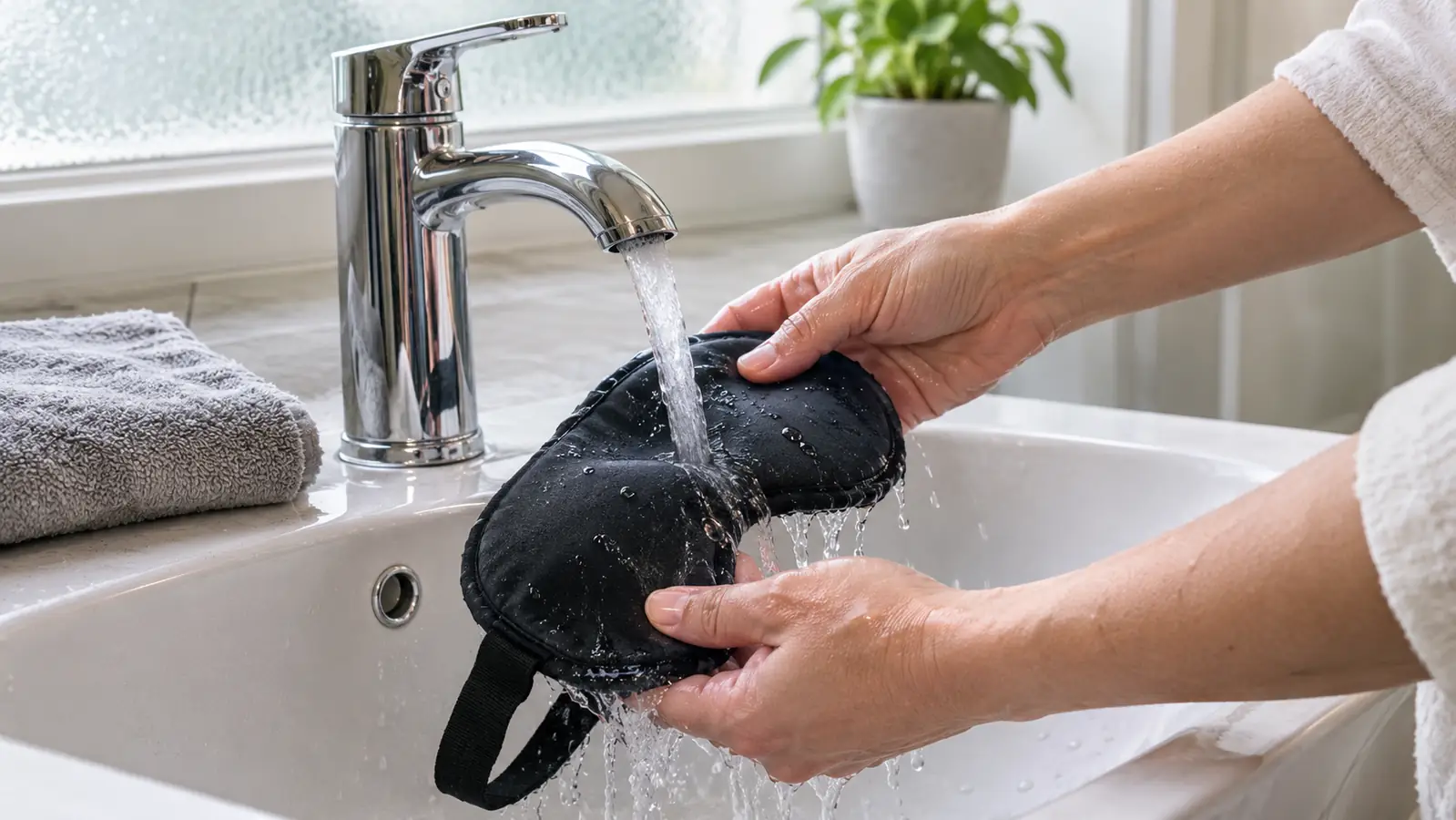
Hand wash only is stamped on the care instructions and they mean it. Memory foam does not survive a washing machine. Try it and you will get a mask that has lost its shape and a drum full of foam crumbs. So every Sunday I fill the bathroom sink with cool water and a little mild soap, work it through with my fingers, rinse it, and press it between two towels. Then it sits on the edge of the tub for the rest of the day. If I start that at noon it is dry by bedtime. If I start it at 6 p.m., I am sleeping with a damp mask or not sleeping with one at all. That is a real cost, and no product page leads with it.
The second thing is heat. Memory foam holds warmth against your skin, and in the last two weeks of July our bedroom does not cool down until well after midnight even with the air running. There were maybe ten nights last summer where I took the mask off at 2 a.m. because my face was too warm, and I do not regret a single one. If you run hot at night, understand that this is a small insulated pad on your face. Linda runs warmer than I do and she did not keep it after trying it a few times, though she also does not like anything touching her face, so I would not read too much into that.
The strap is adjustable and closes with a buckle, and getting it right took me about a week. Too loose and the seal at the nose breaks when you roll over. Too tight and you feel it behind your ears by 3 a.m. The trick is to set it while you are lying down, not standing at the mirror, because your head changes shape against a pillow. Once I did that I did not touch it again for months. The buckle sits at the back and I have never had it dig in, which surprised me.
Fit Is the Whole Ballgame
Everything above depends on the mask fitting your face, and that is the part I cannot check for you. A contoured mask is built around a nose bridge of a certain depth and a certain width between the eyes. Mine fits, and I have an ordinary, fairly wide face. On Linda it sat lower than she wanted. The 22mm nose padding is generous, which means it seals on most faces, but generous padding is also the thing that can press on the sides of your nose if your bridge is narrow. Give it four or five nights before you decide. Every sleep mask I have ever owned felt wrong on night one.
One more note on fit, because it cost me a week of fiddling. Wear it for a full hour before bed the first night, in a lit room, doing nothing in particular. You want to feel where the padding touches and where it does not. If the seal is broken at the nose, the strap is usually the answer, not the mask. If the cups press uncomfortably on the inner corners of your eyes, tightening will only make it worse, and you should loosen and try again rather than haul it tighter. That is the opposite of what I did for the first three nights.
What I'd Compare It To Before You Buy
The obvious alternative is a flat silk or satin mask, and it is a real alternative, not something I am setting up to knock down. A flat mask is lighter, it packs flat, and plenty of people sleep fine in one. My problem with every flat mask I owned was the eyelash contact and the gap at the nose, and no amount of adjusting ever fixed either one. If you have never had trouble with a flat mask, you already own the thing you need. This purchase only makes sense if light is beating you and the flat mask is the reason.
The other option is blackout curtains, which is a bigger project than it sounds in a 1960s split-level with odd sized windows. I looked into custom blinds once and then put the money into the mask instead. Curtains fix the window. They do not fix a hallway light coming under the door, a clock face on the dresser, or the 3 p.m. sun during a nap. The mask goes where the light is. That is why it earned the nightstand and the curtains never got ordered.
Who This Is For
This is for the person whose bedroom is never quite dark, who has tried a flat mask and woken up with it around their neck, and who sleeps on their side. It is for people who blink themselves awake, which is more of us than will admit it. If a stripe of light on the ceiling keeps you company at two in the morning, this is the most direct fix I have found in three years of chipping away at bad sleep, and I found it after the white noise machine, not before.
Who Should Skip It
Skip it if you need something you can fold into a Dopp kit or a jacket pocket. Skip it if you run hot and sleep in a room with no air movement, because the foam will hold warmth against your face. Skip it if you are not going to hand wash it, because one machine cycle will end it. And skip the whole category if the problem is not light. If you are snoring loud enough to wake the person beside you, or waking up gasping, a mask will not touch that. My doctor ruled out sleep apnea with a home test a few years back, and I would tell anyone with those symptoms to get the same test before spending anything on sleep gear.
After two and a half years, the honest summary is this. The MZOO mask does the one job I bought it for, it has not fallen apart, and the only thing I actively dislike is the Sunday hand wash. It is not a cure for bad sleep, and nothing is. It removed one specific obstacle, and removing one obstacle at a time is how I went from five broken hours a night to something closer to seven. That is the whole claim I am making, and it is enough.
One obstacle, removed. If light is the obstacle, this is the fix I'd start with.
Contoured memory foam, complete blackout, and a strap that stays put when you roll over. Hand wash only, so plan on a Sunday. Check the current price and the sizing details on Amazon.
Amazon Check Today's Price on Amazon →