
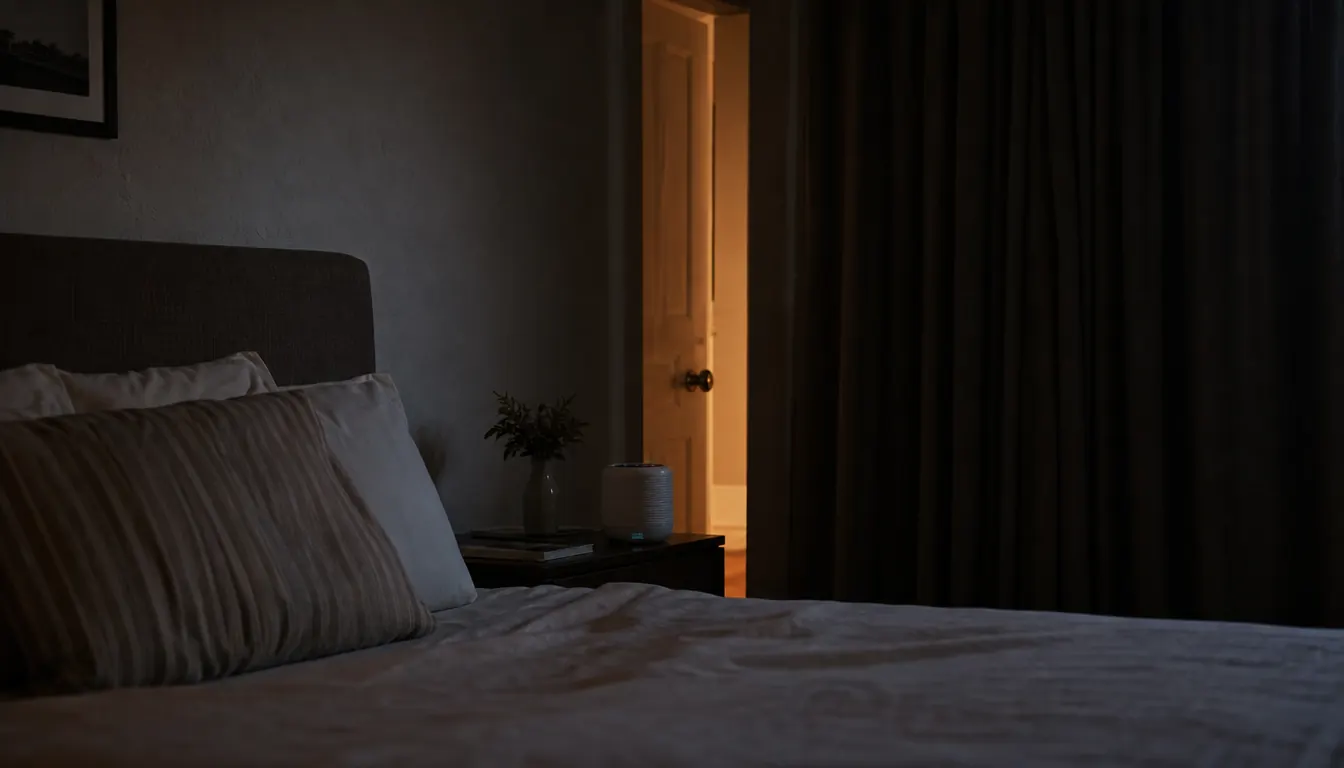
The bus that runs past our house is not loud. That is the part nobody warns you about. It is a low rumble at 5:40, then the air brake, then the window frame buzzing for about four seconds, and then nothing at all. Twenty minutes later it comes back. Our bedroom faces that street, Linda is a light sleeper, and for a couple of years the schedule of a New Jersey bus route set the schedule of our nights.
I tried the obvious things first. Foam earplugs that had my jaw aching by two in the morning. A phone app that played rain through a speaker the size of a dime. A box fan in the corner that moved a lot of air and covered almost no sound. The trouble with all three is that street noise is not one noise. It is a dozen small ones arriving on a timetable, and your brain learns the timetable.
What finally worked was dull. About three years ago I put a Marpac Dohm Classic on my nightstand on the street side, roughly three feet from my head, and turned it on. It has run every night since, including the night we got home from my sister's at midnight. It is a real fan in a housing rather than a speaker, and that turns out to be the entire point.
The one thing on my nightstand that has never taken a night off
The Marpac Dohm Classic is a corded fan in a small housing with two speeds and one job. It is 5.75 inches across, weighs 1.6 pounds, and the seven foot power cable reaches the outlet behind the nightstand without an extension cord.
Amazon Check Today's Price on Amazon →Five Steps, in the Order I Would Do Them Again
Step 1: Find the wall the noise comes in through
Before you buy anything, stand in the room at eleven at night with the lights off and just listen. Not for the loud stuff. For the things that repeat. In our room it was the window on the street wall, the frame that buzzes, and the gap under the door where the hallway of the next building bleeds through. You are hunting a direction, not a volume level, and the direction tells you where the machine belongs.
The instinct is to put the machine on your own nightstand, because that is where you can reach it. Put it where the noise is instead. Mine sits on the street side, three feet from the bed, so the sound travels toward me through the same air the bus comes through. That three feet of placement did more than any volume adjustment I have made since.
The cable is seven feet long, which matters more than it sounds like it should. It reached the outlet behind the nightstand on its own, so there is no extension cord lying across the floor for me to find with my foot at 4:45 in the morning. Small thing. It is the kind of small thing that decides whether a machine stays plugged in for three years.

Step 2: Buy a fan, not a playlist
Every phone has a sound library now. Rain, ocean, a train, a crackling fire, about forty others. I have tried most of them and they fail for the same reason. Your brain is very good at finding a pattern. Rain has a rhythm. A brook has a rhythm. Hand your brain a rhythm at two in the morning and it will follow that rhythm straight into being awake.
A real fan is different because there is nothing to track. Air moves across a housing and what comes out is a broad wash with no pattern in it. That is what covers a bus. The Dohm is built this way. The product listing describes soothing natural sounds from a real fan, and in this case that is a literal description rather than a slogan.
The fan sound also gives your ears something else to hold on to. In a silent room, the air brake is the only event of the night, so it gets all of your attention whether you want to give it or not. In a room with a steady wash in it, the air brake is one small thing inside a bigger thing. Nothing about the bus changed. What changed was how much of my night it got to have.
Step 3: Set the speed and the tone once, then stop fiddling
The Marpac Dohm has two speeds. I use the low one, and I have for three years. The high speed is there for the bad nights, the ones with a garbage truck idling or a neighbor's car with a bad muffler, and I use it maybe a dozen times a year. There is no reason to start on high, and there are several reasons not to.
Tone matters as much as volume. Mine is adjusted partway, which takes the hard edge off the top and leaves a lower sound that sits under the traffic instead of on top of it. Too far one way and it gets hissy. Too far the other way and it sounds like a refrigerator dying. Partway is the setting. It took me about a minute to find and I have not moved it since.
Then leave it alone. That sounds obvious and it is not, because the thing you will want to do at three in the morning is reach over and turn it up. Every time you do, you teach yourself that the machine is a thing to be managed, and a thing to be managed is a thing you stay awake managing. Set it before you get into bed.
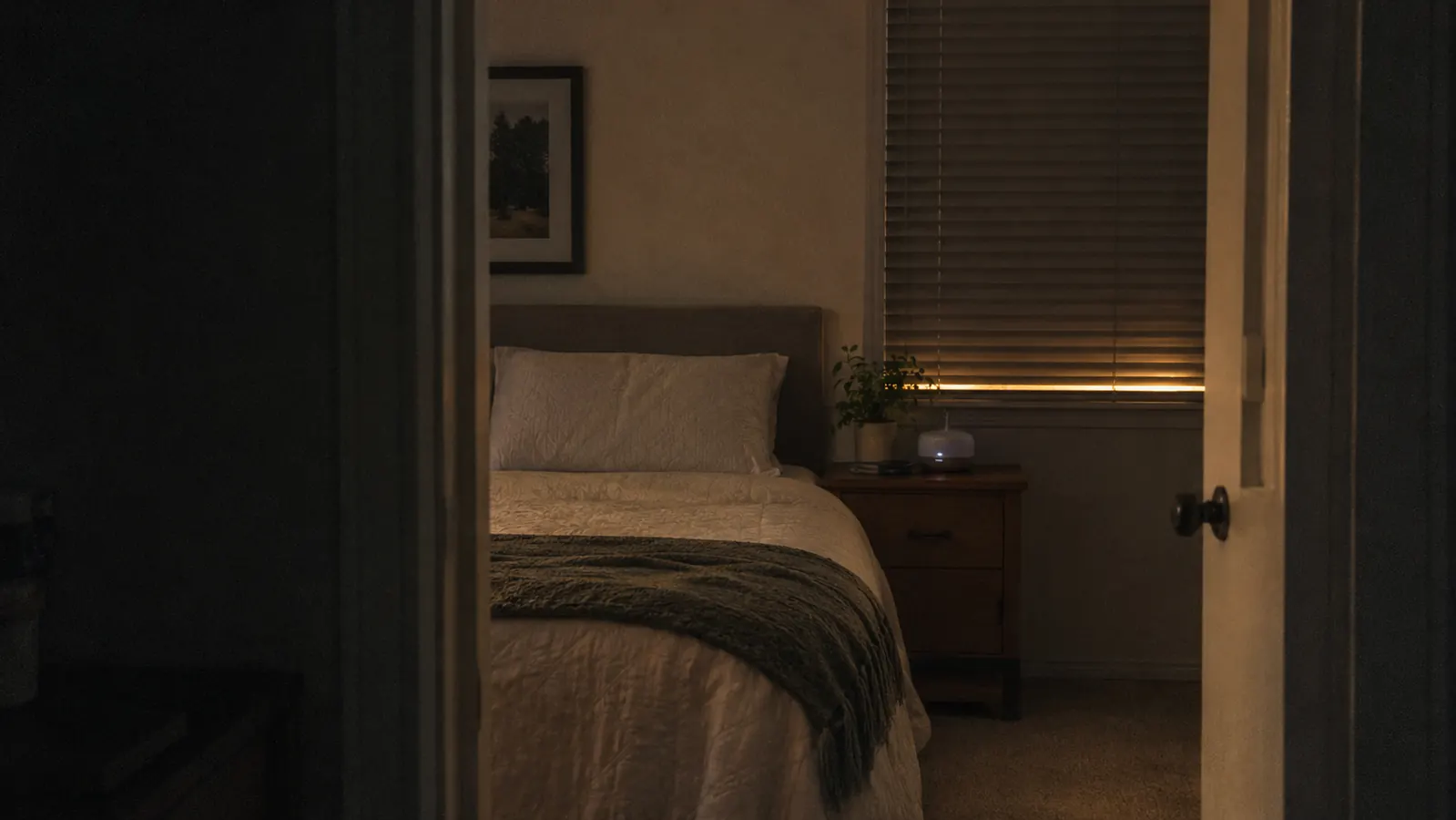
The 5:40 bus still comes. I have not heard it from this room in about three years.
Step 4: Run it all night, not just until you fall asleep
Plenty of people switch the machine off when they get up in the night, or put it on a timer so it stops at two so the room will feel normal again. I understand the reasoning. I do not understand the part where you are asleep at 5:40 with nothing covering the street.
The noise that wakes you is almost never the noise that was there at bedtime. It is the one at 4:12, or the truck at 5:05, or a neighbor warming up the car in January. A machine that quits at two is a machine that quits two hours before the hardest stretch of your night, and you will never know it did.
Mine runs from about 9:30 in the evening until I get up at 4:45 on a weekday, and later on weekends. It is corded, so there is no battery to charge and nothing to remember. That is the trade I wanted. Nothing to check, nothing to top up, nothing that can be flat and silent at two in the morning when you need it most.
Step 5: Give it a full week before you decide
The first night, Linda asked whether it was going to be like this every night. Not warmly. She is a light sleeper, and a new sound in the room is, at first, just one more new sound in the room. That is the honest part of this that no product listing is going to tell you.
It took her about a week. Somewhere around night six or seven she stopped mentioning it, and then she stopped hearing it, which is a different thing entirely. That is what a masking sound does. It stops being a sound and becomes the floor the rest of the night sits on.
One limit worth knowing before you start. A fan covers the middle and upper part of street noise well: the tire hiss, the air brake, the idling. It does less for the very low stuff, a subwoofer two streets over, a truck downshifting on the hill. You will still feel that one in your chest. What the machine does is take the eight or nine smaller noises off the table, so the one deep thump a night does not have a whole silent room to land in.
So give it seven nights before you pack it away. If by night seven you are still listening to the machine instead of the street, change one thing: the other speed, or six inches of position, or a small adjustment to the tone. Change one thing at a time. If it is still wrong after that, it genuinely is not for you, and no amount of adjusting will talk you into it.
What Else Helps
A sound machine covers sound. It does not cover light, or heat, or the committee meeting your head holds at two in the morning. Those needed their own fixes, and I did them one at a time over about three years, which is what I would recommend. Change five things at once and you learn nothing about which one did the work.
The last cheap piece was the door. Our bedroom door sits about a quarter inch off the floor and the hallway carries sound up from the stairwell. A rolled towel along the bottom is not elegant and it is not a product, but it took a whole layer of hallway noise out of the room and made the machine's job smaller. Do the free physical things first. They compound.
The streetlight came through the blinds and laid a stripe across the bed. About two and a half years ago I started wearing a contoured sleep mask and the stripe went away. Linda tried it for a few nights and decided she would rather not, which is fine, because you cannot talk someone into a mask. I wash mine by hand on Sundays, and it also gets me through a nap after a hard shift.
Linda runs warm, and so does that bedroom in July even with the central air going. Two years ago she swapped her pillow for one she could take fill out of, and she pulled some of the foam out in the first week to get the height right. That was her fix. Mine was different, and mine took me longer to admit to.
The racing mind at two in the morning got a weighted blanket about eighteen months ago, 15 pounds, on my side of the bed only. It took me four nights to stop noticing the weight, and Linda has never wanted one. The 4:45 wake-up got a sunrise alarm a year ago, thirty minutes of light coming up before the alarm, replacing a phone that went off like a fire drill. None of those are noise fixes. All of them matter once the noise is handled and you are still lying there awake.
One more thing before I get off it. I snored for years and assumed that was just how I slept. Then I nodded off in the hospital parking lot before a shift, and that scared me enough to make an appointment. My doctor ordered a home sleep test and it came back negative, which was a relief and a nudge both. If you snore loudly, wake up gasping, or fall asleep in the middle of the day, get the test before you buy another gadget. A fan will not fix apnea, and no white noise machine on the market will.
Three years. One nightstand. One switch.
The Marpac Dohm Classic is 5.75 inches across, 1.6 pounds, corded with a seven foot cable, two speeds, and a one year limited warranty. It has outlasted every other sleep purchase in this house, and I have stopped looking for anything better.
Amazon Check Today's Price on Amazon →