
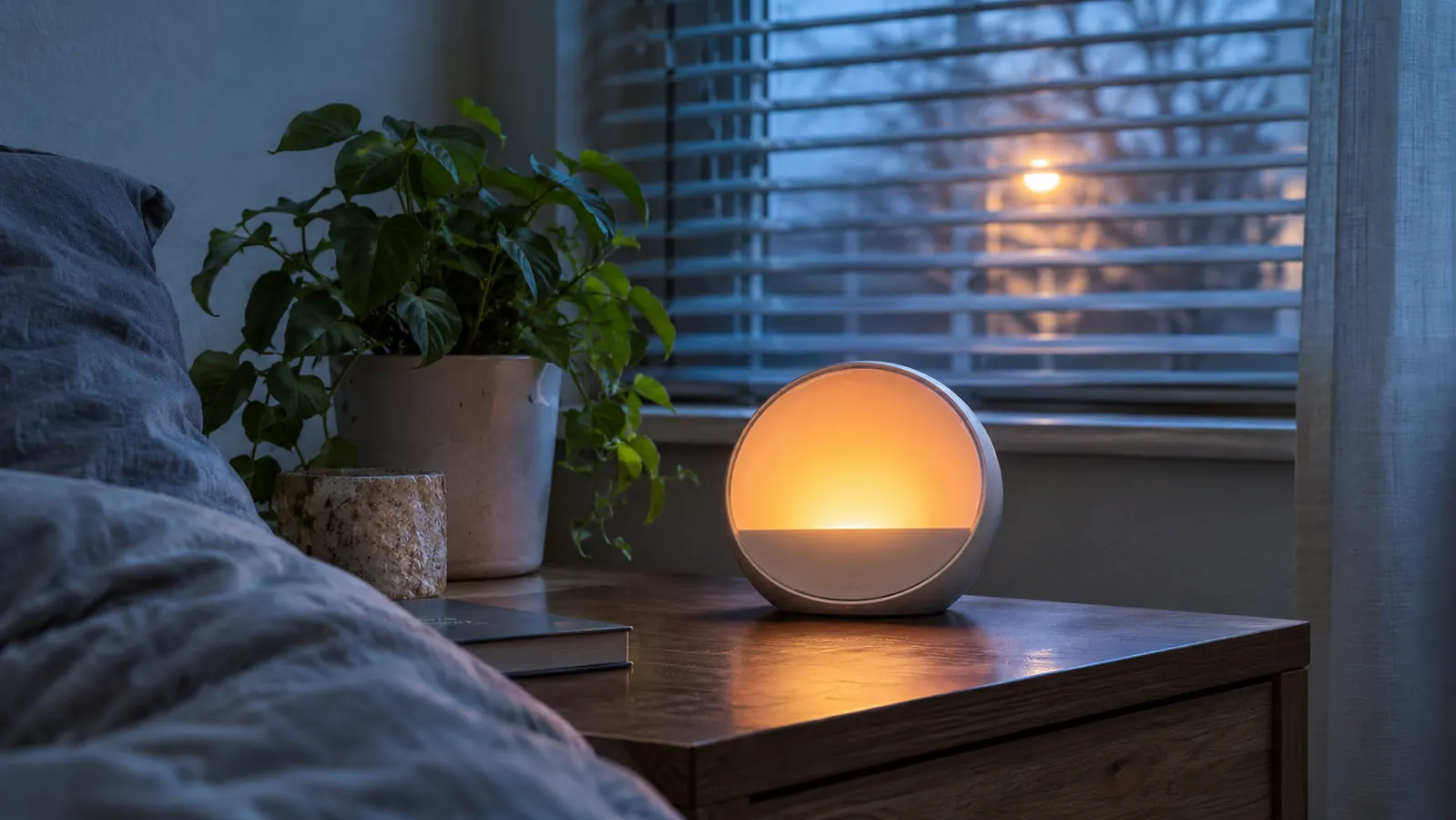
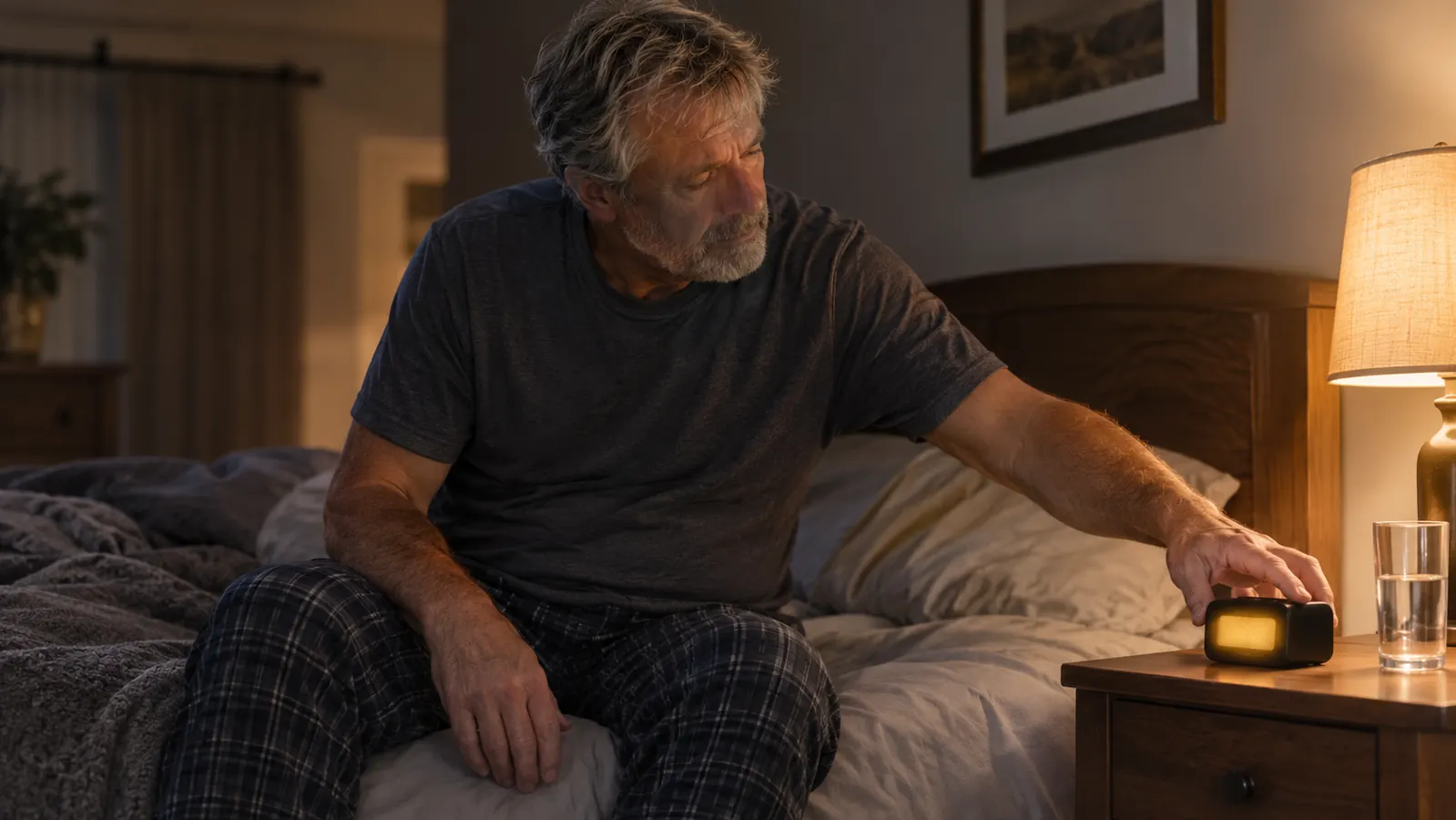
At 4:45 on a Tuesday in February the room is pitch black and my body has decided it is still Wednesday. For years that was the worst ten minutes of my day. Not the shift itself. The tearing out of deep sleep, heart already going, hand slapping around the nightstand for a phone that buzzes like a trapped wasp. Linda would roll over and ask what time it was, and I would already be halfway into my socks before I had an answer for her.
I work building maintenance at a hospital in Clifton, New Jersey, and my shift starts at six. Up at 4:45 on weekdays, in a bedroom that faces a street with a bus route on it, in a 1960s split-level that holds heat like a thermos. About a year ago I put a JALL sunrise alarm clock on my nightstand, on the side away from the white noise machine, and retired the phone alarm for good. The JALL did not fix my sleep. It fixed the last ten minutes of it, and those ten minutes were poisoning the other fourteen hours.
Here is the sequence that made the difference, in the order I would do it again. None of it is complicated. Most of it is about not fighting your own body at the worst possible moment of the night.
The light comes up before the sound does. That is the whole idea.
A full-screen sunrise that brightens over the minutes before the alarm sound, 25 nature sounds, and a separate weekday and weekend alarm so Saturday is not a punishment.
Amazon Check Today's Price on Amazon →The Five Steps, In the Order I'd Do Them
Step 1: Set the Weekday Alarm First and Let the Light Do the Waking
Start with the alarm you actually have to obey, which for me is the 4:45 weekday one. Set it the way you would set any alarm, then let the light come up ahead of it. The JALL runs a full-screen sunrise, the display going from dark to full over the minutes before the sound, so you are not so much woken as slowly handed back to the room.
Here is what that felt like in practice. The first week I woke at the sound anyway, because my body was used to being ambushed and old habits die loud. Somewhere in the second week I started surfacing before it, in that half state where you know morning is coming but nothing is demanding anything from you yet. By the third week the sound was mostly a formality. Ten minutes of that beats a phone buzz, and it is not close.
The clock itself is about seven inches across and sits flat on the nightstand, roughly the footprint of a paperback. Mine has not moved in a year. The snooze can be set anywhere from five to twenty minutes and I landed on ten, long enough to be worth something and short enough that I do not drift back under and wake up angry at myself.
Step 2: Pick a Soft Sound and Set the Volume Low
This is the part people get wrong. The JALL has 25 nature sounds and white noises built in, plus an FM radio, and the temptation is to pick the loudest one because you do not trust the light yet. Do not do that. Pick something soft and set the volume low enough that you would struggle to hear it from the bathroom.
Mine is one of the quieter nature sounds, and I have not changed it in a year, which tells you something about how much it matters. The sound exists to finish a job the light started, not to do the job itself. If it jolts you upright, you have rebuilt the phone alarm with extra steps and better lighting.
The FM radio is there if you want a human voice in the room first thing. I tried it twice. A DJ at 4:45 has a lot of personality for that hour and I went back to the soft stuff. Your mileage may vary, especially if you are the sort of person who wants the news before a shift. I am not that person at that hour.
Step 3: Aim the Screen at Your Face, Not Your Partner's
Where the clock sits matters more than any setting on it. Point the screen toward your side of the bed, not toward the middle of the room and definitely not toward the other pillow. Linda is a light sleeper and the reason she sleeps through most mornings is geometry, not luck. The light faces me. She faces away.
Our bedroom also takes a streetlight straight through the blinds, from a pole nobody has ever come to fix. The sunrise had to add to that light, not compete with it. If your room already glows at night, deal with the blind first and angle the clock second, because a sunrise you cannot distinguish from the ambient glare is not going to do much for you.
A small thing that took me a month to notice. At full brightness the screen is bright enough that I do not want to stare straight into it in the last minute before the sound. I turn my head and let it fill the room instead. That is how the thing is meant to work, a whole room getting lighter, not a searchlight pointed at your eyeballs.
Step 4: Split the Weekday and Weekend Alarms So Saturday Isn't Punishment
The JALL has two alarms and you can set them separately for everyday, weekday, or weekend use. Use that. My weekday alarm is 4:45 and my weekend alarm is 6:30, late enough to feel like a mercy and early enough that Sunday night does not fall apart.
Before this I did what most people do. One alarm for the week, switched off on Friday night, then a Saturday morning spent in a fog of my own making, then a Sunday night lying awake doing arithmetic about how few hours were left. Having a second alarm already set means I never have to make a decision about it at 6 a.m., and deciding things at 6 a.m. is exactly what ruins a Saturday.
Set both of them on a Sunday evening and leave them alone. That is the entire step. Two minutes once, and then it is handled for the year apart from the odd holiday or dentist appointment.
Step 5: Use the Sleep Timer So the Sound Fades After You're Out
At night the same clock earns its spot on the nightstand. It has a sleep timer that runs anywhere from ten minutes to eight hours, so the sound can fade out after you are under instead of running until morning like a roommate who will not take a hint.
I set mine for about three quarters of an hour, longer than I need and short enough that it is off before the deep part of the night. The white noise machine handles the bus route from then on. Two devices, two jobs, no overlap, nothing running all night out of habit.
If you share a bed with someone who falls asleep at a different hour, learn this setting first. A sound that stops on its own is a far easier sell than one that keeps going until dawn. It is also the difference between a gadget your partner tolerates and one they ask you to move to the garage.
Three weeks in, the sound stopped being the thing that woke me. The light was doing it. That is the whole test, and it is why the phone alarm never came back.
What Else Helps
Light is one input. It is not the only one, and it will not carry a bad night on its own.
Temperature first. Our bedroom runs warm in summer and Linda runs warm all year, so the room stays cool and the heavy bedding goes away in July and August. A cool room and a light that comes up slowly do more together than either does alone. I have never once regretted getting up to close a window at 2 a.m. I have regretted every night I did not.
Then the streetlight. A contoured sleep mask has done more for my 2 a.m. wake-ups than any other object in that room, and I say that as someone who bought one expecting to hate it. If you are up at two because the room is not actually dark, no sunrise clock on earth is going to help you at 4:45.
And if you snore loudly, wake up gasping, or find yourself nodding off in a parked car before a shift, put the gadgets down and go get a home sleep test. I did, about three years ago, after I fell asleep in the hospital parking lot with the engine running. It ruled out apnea, and that answer was worth more than everything on my nightstand combined.
What It Does Not Do
It does not fix a mind that will not stop. My 2 a.m. problem is a separate problem, and the sunrise clock has nothing to say about it. A weighted blanket and a hard rule about not checking my phone after nine have done more for that than any piece of electronics.
It wants a USB outlet, and it takes a single AA battery that does not come in the box. Buy the battery the same afternoon, not at nine at night while you are standing there with the manual open.
The setup takes an evening. There are 17 light modes and 25 sounds in there, and you will page through all of them once, pick two, and never touch the rest again. Budget twenty minutes for the first night and do not try to do it at bedtime.
And it will not save a heavy sleeper who keeps blackout curtains shut and a phone within arm's reach. If you go back to the phone, the light is a very expensive nightlight with a nice glow.
Who This Is For
Anyone who gets up before the sun and does it in a room that is still black. Nurses, drivers, bakery staff, parents of small children, and the substantial population of people whose shift starts before the streetlights go off. If your alarm currently drags you out of sleep like a fire drill, this is the change with the best ratio of effort to result that I have found.
It is also for the person sharing that bed who is tired of being woken by the fallout. Linda has not been woken by my alarm in months, which she mentions roughly once a week in the tone of someone who has not forgotten the years when she was.
Start with the weekday alarm and the soft sound. Leave the seventeen light modes alone until you have a reason. A year in, that is still all I use, and it still works at 4:45 in February.
The 4:45 wake-up is happening either way. The only question is how you arrive at it.
Full-screen sunrise, 25 nature sounds, separate weekday and weekend alarms, and a sleep timer for the other end of the night. Mine has been on the same nightstand for a year.
Amazon Check Today's Price on Amazon →